
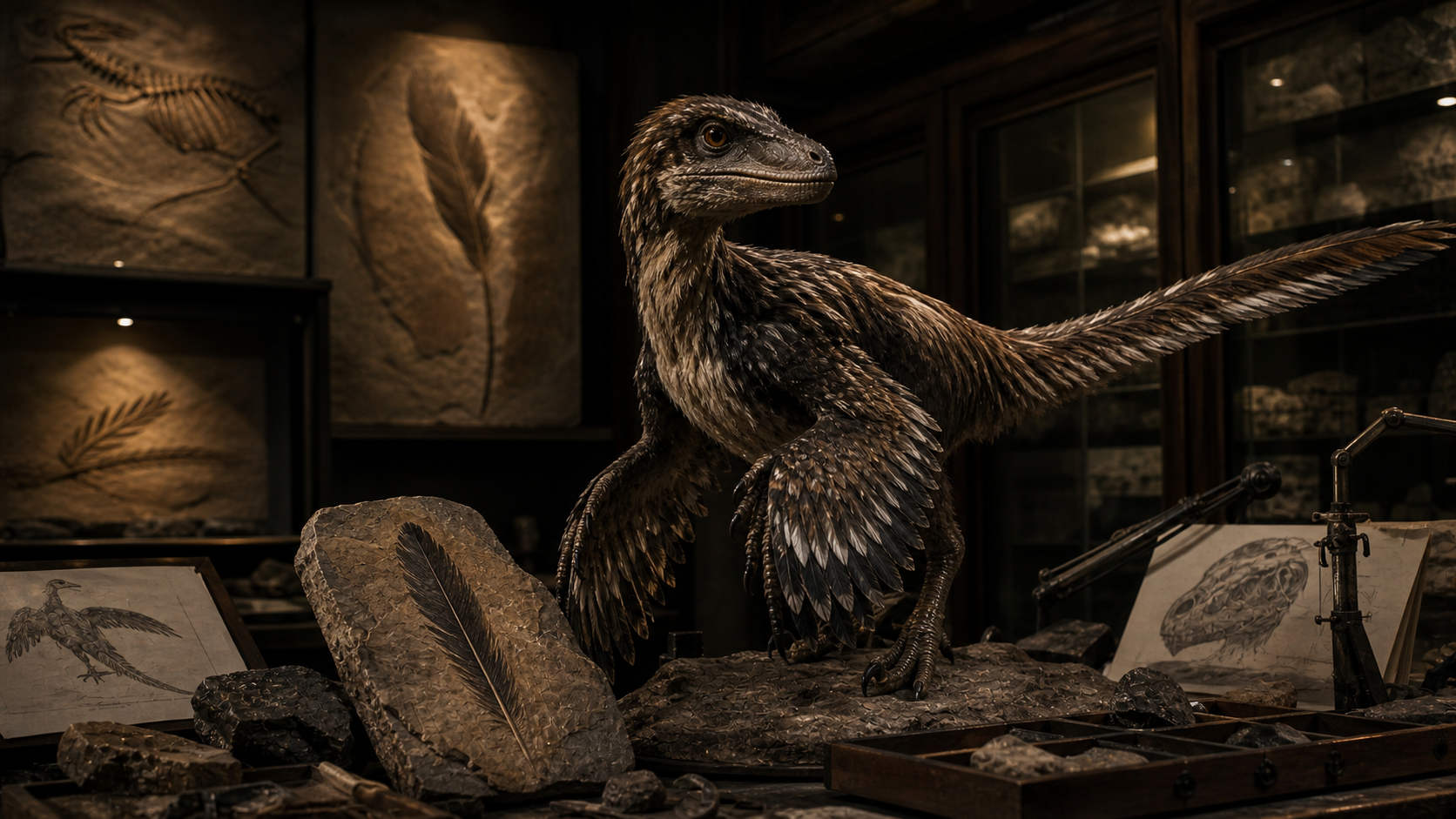
Why Some Dinosaurs May Have Had Feathers Instead of Scales
The scaly dinosaur image is not the default anymore. Fossils show feathers were widespread across major dinosaur lineages.
The dinosaur of popular imagination is scaly. It is large, reptilian, cold-looking — a scaled-up lizard draped in leathery skin, designed to look ancient and alien. That image was built over a century of museum displays, film productions, and textbook illustrations. It is also, for a significant portion of the dinosaur family tree, probably wrong. Many dinosaurs were feathered, some of them extravagantly so, and the evidence for this has been accumulating to the point where the scaly default can no longer be assumed.
Short answer: Fossil discoveries from China beginning in the 1990s preserved the direct physical impressions of feathers and feather-like filaments on dinosaur bodies. These fossils, combined with evolutionary analysis of where feathers appear in the dinosaur family tree, suggest that feathers were widespread — not exceptional — across a large branch of dinosaurs. The scaly dinosaur is the image that needs explaining. The feathered one is the baseline.
The Problem With Skin
Skin almost never fossilizes. It is soft tissue, and soft tissue decays rapidly after death, long before the processes of mineralization that preserve bone can act on it. The default assumption in paleontology — that a dinosaur had scales — was not based on positive evidence of scales across most species. It was the absence of contrary evidence, combined with the assumption that dinosaurs, being reptiles, would look like reptiles.
Where dinosaur skin impressions were found in the nineteenth and early twentieth centuries, they tended to show scale-like textures. These impressions came primarily from large, late-Cretaceous dinosaurs — hadrosaurs, ankylosaurs, some ceratopsians — and they did show scales. This reinforced the scaly image across all dinosaurs, even though the sample was geographically and taxonomically narrow.
What was missing was any equivalent evidence from the group of dinosaurs most closely related to birds — the theropods, and particularly the coelurosaurs within that group. No skin impressions from small theropods were available to constrain what they looked like. The scaly assumption filled the gap, and became the image, and then became so established that finding evidence against it required extraordinary fossil preservation.
Liaoning and the Feathered Fossils
The Yixian and Jiufotang formations in Liaoning Province in northeastern China preserve fossils from the Early Cretaceous period — roughly 120 to 130 million years ago — in fine-grained volcanic ash deposits that occasionally capture soft tissue detail. The conditions that produce this preservation are unusual: rapid burial in fine sediment, specific chemical environments, and the absence of the scavenging and bacterial activity that normally destroys soft tissue.
When large-scale fossil collecting in Liaoning began producing specimens in the 1990s, the results were immediately significant. Sinosauropteryx, described in 1996, was the first non-avian dinosaur found with clear evidence of integumentary filaments — structures on the body surface that were not scales. They were simple, hair-like filaments running along the back and tail, not complex pennaceous feathers, but they were unambiguously not scales.
Subsequent discoveries multiplied rapidly. Caudipteryx had complex pennaceous feathers on its arms and tail. Microraptor had feathers on all four limbs, suggesting it may have been capable of some form of gliding. Anchiornis, a small theropod closely related to birds, was found with feathers covering most of its body — and in specimens preserved with enough pigment cell detail to reconstruct its coloring: black and white with a rufous crest, specific enough to rule out the generic gray-green of earlier reconstructions.
What the Evolutionary Tree Tells Us
Individual fossil specimens are compelling, but the broader picture comes from placing feathered dinosaurs within the evolutionary tree of all dinosaurs and asking where feathers appear. When this is done, feathers — or feather-like integumentary structures — appear to be ancestral to a very large group of dinosaurs called coelurosaurs, which includes tyrannosaurs, ornithomimosaurs, oviraptorosaurs, dromaeosaurs, troodontids, and birds.
If feathers are ancestral to coelurosaurs as a group, the implication is significant: all coelurosaurs likely had some form of feathering unless they secondarily lost it. Loss of feathers, in this framework, requires explanation — it is not the default. This is a complete inversion of the earlier assumption, where feathers required explanation and scales were the starting point.
The evidence for where feathers appear in the tree is not complete. Fossils with preserved feather impressions are rare, and absence of feather evidence is not evidence of absence of feathers. But the pattern that has emerged from the Liaoning material and from other preservation windows around the world places feathers deep in the coelurosaur lineage — closer to the root than to the birds at the tips.
Tyrannosaurs and the Feather Question
The case of tyrannosaurs is the one that attracts most attention, partly because of the visual stakes — a feathered Tyrannosaurus rex is a dramatic revision of one of the most recognized animals in popular culture — and partly because the evidence is genuinely uncertain.
Yutyrannus huali, a large tyrannosaur from the Liaoning formation described in 2012, is preserved with clear filamentous feathers across its body. At roughly nine meters long and over a thousand kilograms, Yutyrannus is the largest animal known to have had feathers. Its existence demonstrates that large tyrannosaurs could be feathered. It does not demonstrate that T. rex specifically was.
Skin impressions from T. rex and its close relatives — found in several specimens — show scales on parts of the body, including the neck, hips, and tail. This has been interpreted by some researchers as evidence that large tyrannosaurs were predominantly scaly, perhaps having lost ancestral feathers as body size increased and the thermoregulatory benefits of insulation became less important or actively disadvantageous. Other researchers argue that scale impressions from a few body regions do not rule out feathering elsewhere, particularly on the head, back, and shoulders where preservation is rarely available.
What Feathers Were Actually For
The presence of feathers in dinosaurs predates powered flight by a considerable margin. The earliest feather-like filaments — simple, unbranched structures — appear in dinosaurs that clearly could not fly and were not closely related to anything that would eventually fly. This means feathers were not invented for flight. They were doing something else first.
The leading hypotheses for the original function of feathers involve thermoregulation and display. Simple filaments covering the body provide insulation — evidence that at least some dinosaurs were endothermic, or warm-blooded, and needed to retain body heat. Display is supported by the elaborate pennaceous feathers found on the arms and tails of dinosaurs like Caudipteryx and Microraptor, where the structures are too large and too conspicuous to be explained by insulation alone. The bright, specific coloring reconstructed for Anchiornis is most easily explained as a signal — to rivals, to mates, or to both.
Flight came later, as a secondary use of structures that already existed and were already elaborated for other purposes. The aerodynamic feathers of modern birds are a derived feature, built on a foundation of filaments and display structures that originated in the context of ground-living dinosaurs that were not flying and had no immediate ancestors that flew.
| Dinosaur | Feather evidence | Approximate date described |
|---|---|---|
| Sinosauropteryx | Simple filamentous covering | 1996 |
| Caudipteryx | Complex pennaceous arm and tail feathers | 1998 |
| Microraptor | Four-winged feathering on all limbs | 2003 |
| Anchiornis | Full body feathering with reconstructed color pattern | 2009 |
| Yutyrannus huali | Filamentous feathers on a 9-meter tyrannosaur | 2012 |
The Color of Dinosaurs
One of the most unexpected developments of the feathered dinosaur discoveries is the ability to reconstruct color. Melanosomes — the cellular structures that produce pigment in feathers — preserve in the fossil record as microscopic shapes. Different melanosome shapes produce different colors in modern birds: sausage-shaped melanosomes produce black and gray, spherical ones produce rufous and reddish tones, and their arrangement in layers produces iridescence.
By comparing melanosome shapes in fossil feathers to the shapes found in feathers of known color in living birds, researchers have been able to reconstruct the color patterns of several feathered dinosaurs with reasonable confidence. Anchiornis was black and white with a red-speckled crest. Microraptor's feathers were iridescent black. Psittacosaurus, a beaked dinosaur not closely related to the feathered coelurosaurs, had countershading — darker above, lighter below — consistent with living in an environment with overhead light sources.
These color reconstructions represent a fundamental shift in how dinosaurs can be known. They are no longer necessarily gray-green unknowns painted by guesswork. For those species where melanosome data is available, the colors are inferred from physical evidence. The bright, specific, socially communicative coloring that emerges from this evidence reinforces the picture of feathered dinosaurs not as sluggish, drab reptiles but as visually complex, socially active animals whose appearance was doing significant biological work.
What the Feathered Dinosaur Changes
The feathered dinosaur is not simply a visual update to an old image. It is a conceptual revision of what kind of animal a dinosaur was. A feathered, warm-blooded, socially signaling animal that nested, possibly cared for its young, and had color patterns that communicated across individuals is not the cold, solitary, stimulus-driven reptile that the scaly image implied.
It is, in many respects, more like a bird than like a crocodile — which is exactly what the evolutionary evidence predicts, since birds are dinosaurs and the living relatives of non-avian dinosaurs are birds, not crocodilians. The scaly image was built on the wrong analogy. The feathered image is built on the right one.
The image will keep changing. New fossils will clarify which species were feathered, to what extent, and in what patterns. New analytical techniques will recover biological information from fossils that currently appear to contain none. What the Liaoning discoveries established — definitively, irrevocably — is that the question of what dinosaurs looked like is a scientific question with scientific answers, and that the answers are more interesting, and stranger, than the century of assumptions that preceded them.