
Why Old Dolls Make People Uneasy
Antique dolls unsettle people because they look human enough to trigger face-reading systems, but not human enough to satisfy them.
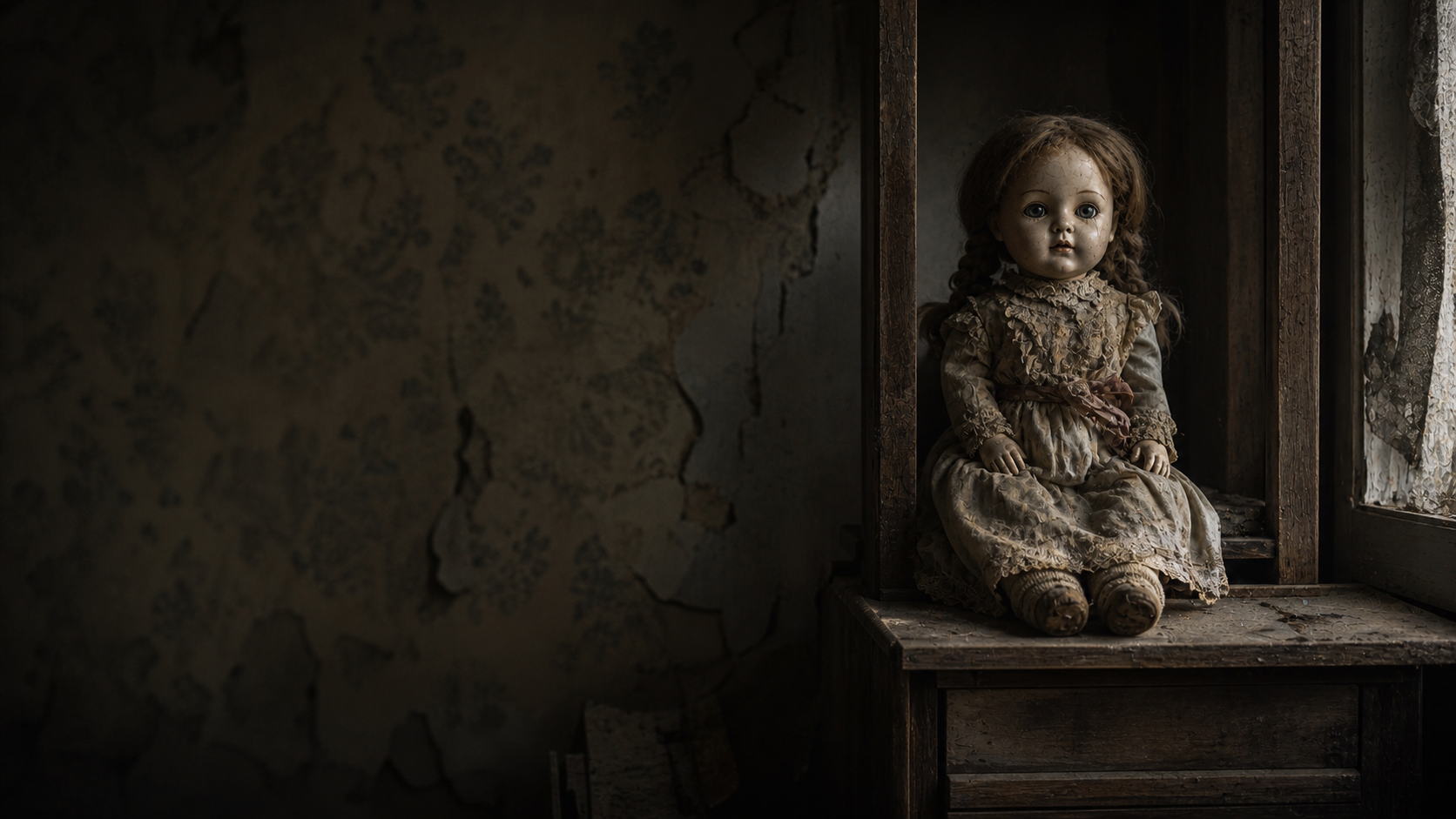
An old doll sitting on a shelf. Glass eyes that catch the light in an odd way. A face that was meant to look like a child but lands somewhere slightly wrong. The unease most people feel in the presence of antique dolls is immediate, specific, and remarkably hard to talk out of. People who know the doll belonged to a great-grandmother, who know it is made of porcelain and stuffing and paint, still feel it.
Short answer: Old dolls trigger a combination of perceptual and psychological responses rooted in how the brain processes faces, detects social signals, and responds to things that appear human without being human. The unease is not irrational. It is a set of correctly functioning systems responding to a genuinely unusual object.
The Uncanny Valley and Why Dolls Live There
The uncanny valley is the term for a well-documented perceptual phenomenon: as something becomes more human-looking, it becomes more appealing up to a point. Then, when it is close to human but not quite, it becomes deeply unsettling. The dip in the graph, the valley, is the zone where something is almost-but-not-quite human.
Old dolls sit in the uncanny valley more reliably than most objects. They were designed to approximate the human face, particularly the face of a young child, but the materials and techniques available when most antique dolls were made produced approximations that are noticeably wrong. The eyes are too large or fixed in the wrong direction. The skin texture is uniform in a way that real skin never is. The expression is frozen in something that looks like it was meant to be neutral but reads as slightly blank, slightly wrong.
Modern toy design has learned to avoid the uncanny valley by moving away from photorealistic faces. Most contemporary dolls for children are stylized: large eyes, simplified features, colors that do not try to match human skin. Antique dolls did not have this option. They aimed for realism and landed in the valley.
Glass Eyes and What They Signal
Many antique dolls have glass eyes, which were considered a premium feature at the time of manufacture. Glass eyes are more lifelike than painted ones in some respects; they have depth and reflectivity that paint cannot replicate. But they are also, in practice, more unsettling than painted eyes for the same reason.
The human brain is exceptionally sensitive to eyes. Eyes are the primary site of social attention and communication. They carry information about emotional state, focus, and intent. The brain reads eyes constantly and automatically, and it distinguishes between eyes that are genuinely present, looking from behind a mind, and eyes that are merely visual.
Glass eyes have the right shape and the right reflectivity. But they do not move. They do not adjust. They catch light in ways that do not correspond to natural eye behavior. The brain’s social processing system registers this as off: these eyes look real, but they are not communicating anything.
The Frozen Expression
Human faces are constantly in motion. Micro-expressions, small muscle adjustments, and the continuous shifts that accompany breathing and movement mean a living face is always slightly changing. A doll’s face is fixed at a single expression, forever.
This creates a specific problem for human perception. The brain reads faces automatically and continuously, looking for the small signals that tell it what the person is feeling and intending. When a face is fixed, those signals are absent. The brain keeps looking for them and keeps not finding them. The result is a kind of perceptual frustration: the face looks like a face, it is being processed like a face, but it is not yielding the information that faces are supposed to yield.
Antique dolls compound this with expressions that were often modeled on what nineteenth and early twentieth-century manufacturers thought children’s faces looked like in a neutral, pleasing state. That aesthetic differs from the contemporary idea of a friendly or approachable expression in ways that are difficult to articulate but easy to register: a faint archaic quality that makes the face feel alien even before any other disturbing features are noticed.
Age and the Signs of Deterioration
Old dolls are, by definition, old. And age on an object that was designed to look human produces specific effects that are not present on objects that were never designed to look human. When a wooden table deteriorates, it looks like a deteriorating table. When a human-like face deteriorates, the visual vocabulary of human decline applies.
Cracked porcelain suggests broken skin. Fading paint suggests the loss of healthy color. Hair that has become brittle and sparse reads against the template of human hair loss. The doll is not a human face in decline, but it is close enough to one that the brain processes the deterioration through that template. The result is a response that combines the normal unease of the uncanny valley with additional signals from the brain’s mortality-awareness systems.
Useful distinction: The doll is not being mistaken for a person. It is triggering systems normally reserved for people, and those systems are finding signals that do not resolve cleanly.
This is not a conscious process. No one looking at a cracked antique doll thinks: this face resembles a dying person. But the visual processing systems that respond to human faces are reading those signals below the threshold of conscious awareness and producing a response, an involuntary recoil, that the conscious mind then tries to rationalize.
The History They Carry
Old dolls also carry a historical weight that newer objects do not. A mass-produced toy from this year is known to have come from a factory. An antique doll from a hundred years ago has an implied history: owners, places, events, usually undocumented.
This implied history activates a kind of associative unease. Who owned this? What happened to them? The doll has survived its original context entirely. It outlasted the child it was given to. It has witnessed events that no longer have witnesses. And it looks back at you with fixed glass eyes that have seen things you cannot know.
This combination of personal history and inscrutability is part of what makes antique dolls feel different from antique furniture. A chair from 1890 does not look back at you. A doll does, or does something close enough to looking back that the difference does not help much.
| Feature | Why it unsettles |
|---|---|
| Human-like face, imperfectly rendered | Uncanny valley: close but wrong |
| Fixed glass eyes | Social signals without social presence |
| Frozen expression | Face-reading systems find no information |
| Deterioration over time | Human-decline vocabulary applied to a face |
| Unknown personal history | Implied past without documentation |
Why the Feeling Persists Even When You Know Better
One of the most noted features of doll-related unease is its persistence in the face of rational knowledge. People who know perfectly well that an antique doll is a manufactured object made of inert materials still feel uneasy around them. Knowing does not turn off the feeling.
This is characteristic of responses that are generated by perceptual systems rather than cognitive ones. The uncanny valley effect, the face-reading system, and social signal processing all operate below the level of conscious reasoning. They produce their outputs before the mind has a chance to apply what it knows. And by the time the rational mind arrives with the reassurance that it is just a doll, the emotional response is already running.
This is not a design flaw in human cognition. These systems are fast because speed matters. A face-like pattern is analyzed immediately, before the brain has confirmed whether it is actually a face. By the time the analysis is complete, the initial response has already happened.
What Old Dolls Reveal About Human Perception
The unease generated by old dolls is a surprisingly rich window into how human perception works. It shows that the brain’s face-processing systems are sensitive enough to be triggered by imperfect approximations. It shows that social processing runs continuously and automatically, seeking signals even from objects that cannot provide them. It shows that deterioration is read through human templates when the deteriorating object resembles a human face.
And it shows that some responses are structurally immune to rational override. You can know it is just a doll. You can tell yourself that the eyes are glass. You can understand every mechanism behind the feeling. The doll will still look back at you from across the room, and the feeling will still be there.
That persistence is not a weakness. It is what a well-functioning perceptual system looks like: fast, sensitive, calibrated toward the things that matter most to human social life, and unwilling to be argued out of its outputs by a conscious mind that arrived a few milliseconds too late.