
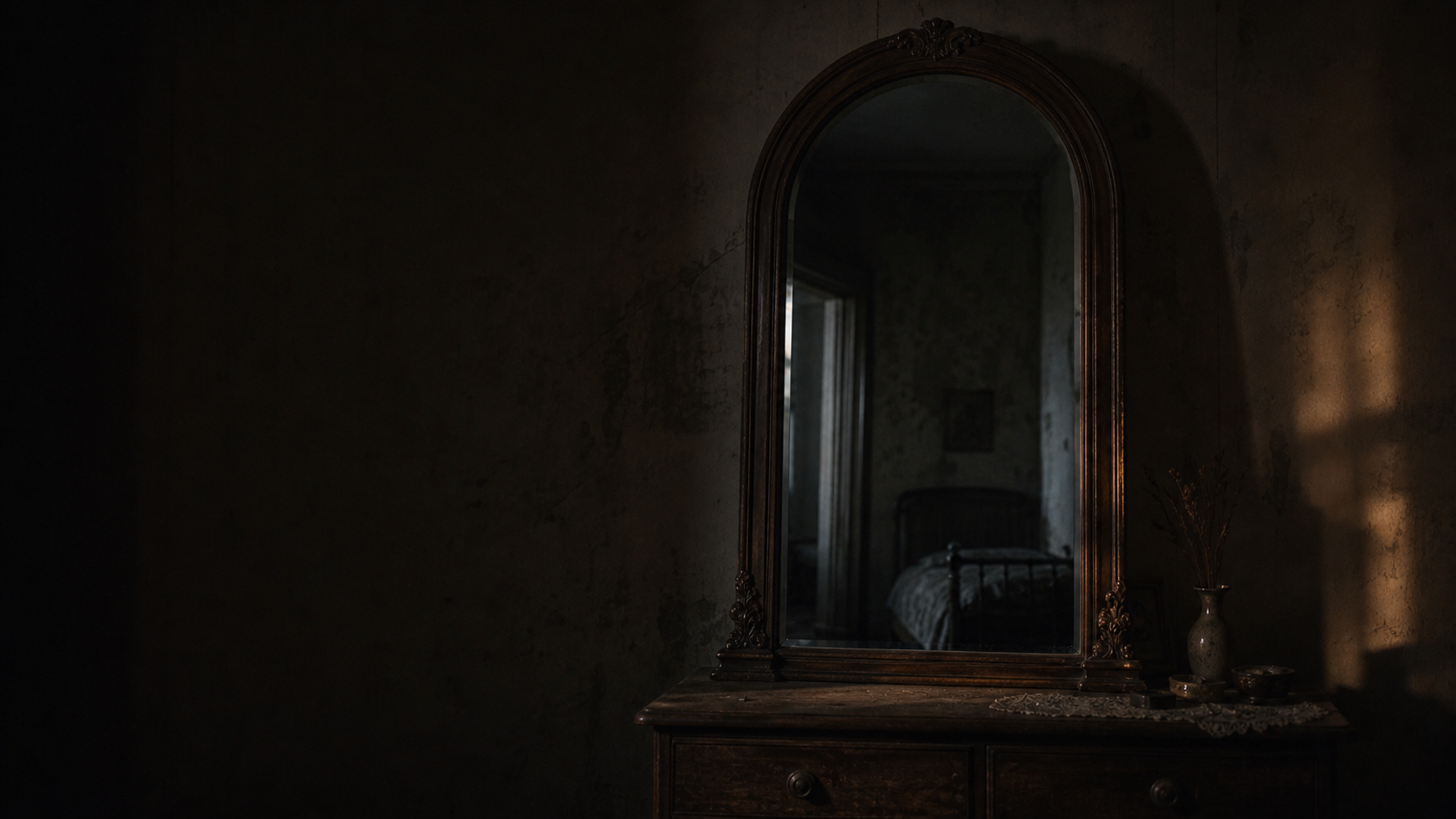
Why Mirrors Feel Stranger in the Dark
Low light turns mirrors into perceptual puzzles, making your own reflection feel less stable than it should.
There is a specific quality to looking at a mirror in a dark room. Daylight mirrors are mundane — you check your appearance, you move on. But dim the light, let the room settle into shadow, and the same mirror becomes something else. The reflection looks right, but it does not feel right. Something in the quality of the image, the depth of the dark behind your reflection, the slight delay the brain invents where none exists — all of it adds up to a feeling that is hard to dismiss even when you know exactly what you are looking at.
Short answer: Mirrors in low light exploit several features of human perception simultaneously. Reduced visual information forces the brain to fill in gaps with inference. Face-processing systems work harder and produce less reliable results. And the mirror’s depth illusion — the sense that there is a space behind the glass — becomes more convincing, and more unsettling, when you cannot clearly see its limits.
What Changes When the Light Goes Down
In good light, a mirror is easy to process. You see yourself clearly, the reflection matches expectations, and the brain files it as a straightforward visual event. The mirror is a surface. The reflection is you. Everything resolves.
Low light changes the input. The reflection becomes less defined. Contrast drops. Detail disappears from the edges. The image you see is no longer sharp enough to match expectations cleanly — and the brain, which is always trying to resolve what it sees into a clear, stable interpretation, starts working harder.
When the brain works harder to interpret a visual scene, it relies more heavily on prediction. It fills in what it cannot clearly see with what it expects to be there, drawing on pattern recognition and prior experience. In a dark mirror, this means the brain is partly seeing you and partly constructing you — and the construction does not always feel right, because the data supporting it is thin.
The Face-Processing System Under Pressure
The brain devotes significant processing resources to faces. It recognizes them faster than any other category of object, reads them for emotional and social information automatically, and continues to process them even when the visual signal is degraded.
In a dim mirror, your own face is a degraded signal. The features are there, but they are softer, less defined, harder to resolve into the precise image you are used to seeing. The face-processing system does not stop working in these conditions — it keeps trying to read the face, keeps trying to extract social information from the reflection. But the information it gets back is ambiguous.
Ambiguity in face-reading produces unease. The brain expects a face to be readable, and when it is not — when the expression is unclear, when the features do not quite resolve — the default response is mild threat activation. Something about this face is not right. The fact that the face in question is your own does not exempt it from this response.
The Depth That Should Not Be There
Mirrors create a depth illusion. They appear to contain a space — the reflected room, extending behind the glass. In good light, this illusion is transparent: you see the reflection clearly enough to understand it as a reflection. The brain accepts the illusion and processes it correctly.
In dim light, the depth illusion becomes more convincing in the wrong direction. The darkness behind your reflection does not terminate clearly at the wall. It extends, or seems to extend, into a space that is difficult to visually bound. The reflected room becomes uncertain. The limits of the glass become ambiguous. And the space behind the image of your face starts to look less like a reflected wall and more like a room you cannot fully see into.
This is why the classic dark mirror anxiety involves looking at your own reflection and worrying about what might be standing behind it. Rationally, you know the mirror shows the room behind you. But the visual uncertainty — the inability to clearly see the limits and contents of the reflected space — creates a gap that the imagination fills with threat.
The Troxler Effect and What Your Reflection Does
There is a real perceptual phenomenon, documented in vision science, that occurs when you stare at a fixed point in your visual field for long enough. The surrounding visual information begins to fade — peripheral details disappear, features blur, the image at the edge of your attention becomes unstable. This is called the Troxler effect, and it happens in dark mirrors with unusual reliability.
When you look at your own reflection in a dim mirror, holding your gaze on your own eyes, the surrounding features of your face begin to shift. The brain, receiving low-quality visual input and working to maintain a stable image, starts producing anomalies. Features seem to move. Proportions seem wrong. The expression appears to change.
None of this is happening in the mirror. All of it is happening in the visual processing system. But the output — a face that appears to be shifting, an expression that does not quite match what you are doing — is real enough to produce a genuine response. The face looking back at you from the dark mirror is not quite your face anymore. And the part of your mind responsible for detecting threats in faces is not reassured by the fact that the difference is neurological.
Why Your Own Reflection Becomes Unfamiliar
There is a psychological phenomenon called depersonalization — the sense that you have become unfamiliar to yourself, that your face in the mirror belongs to someone you do not quite recognize. It can be triggered by stress, fatigue, prolonged mirror-gazing, or by precisely the conditions that a dark room produces: degraded visual input, sustained attention on your own face, and the mild anxiety that comes from not being able to see clearly.
In a dim mirror, the conditions for a mild version of this effect are reliably present. The face you see is harder to resolve. The features do not quite match the crisp internal image you have of yourself. The reflection is doing something slightly off — not moving wrong, not expressing wrong, but hovering at the edge of recognizability in a way that the brain finds destabilizing.
This is why people sometimes avoid looking at mirrors in the dark even when they know, intellectually, that the mirror is just a surface and the reflection is just them. The knowing does not override the output of perceptual systems that are working with inadequate data and producing conclusions that feel wrong.
| Condition | What it does to mirror perception |
|---|---|
| Low light | Reduces detail; forces brain to fill gaps with prediction |
| Degraded facial image | Triggers face-reading system to work harder on bad data |
| Depth illusion without clear limits | Creates sense of inaccessible space behind reflection |
| Sustained gaze | Activates Troxler fading; features appear to shift |
| Mild anxiety from uncertainty | Heightens sensitivity to perceived anomalies |
The Cultural Weight Behind the Feeling
Mirrors have carried symbolic weight in almost every culture that has produced them. They have been associated with the soul, with the dead, with truth, with deception, with alternate worlds. Mirrors in folklore are routinely the site where the ordinary becomes strange — where something that should reflect faithfully instead shows something different.
This cultural weight does not cause the dark mirror effect, but it reinforces it. When the brain is already producing anomalous perceptual outputs — an unstable face, an uncertain depth, a reflection that does not quite resolve — the cultural associations activate additional layers of unease. The mirror feels like a threshold. The reflection feels like it might not be entirely you.
That feeling has a perceptual basis. It is not folklore generating fear from nothing. It is the brain’s perceptual systems producing unusual outputs under low-light conditions, and cultural history providing a framework for understanding those outputs as significant. The dark mirror is genuinely stranger than its daytime counterpart. The strangeness is real. It just lives in the nervous system rather than in the glass.
What the Dark Mirror Actually Shows You
What a mirror in the dark shows you is the limit of your own visual system. It shows you how much of normal perception depends on good information — how much the brain is constructing rather than receiving, filling in rather than faithfully recording. And it shows you what happens when the construction process runs on insufficient data.
The face in the dark mirror is not a stranger. It is you, imperfectly reconstructed by a system that was not designed to work well in near-darkness, and read by face-processing software that flags ambiguity as threat. The space behind the reflection is not inhabited. It is the depth illusion behaving oddly under conditions that reveal how unconvincing it really is.
None of that makes the feeling go away. Knowing that the unease is perceptual rather than supernatural does not reroute the processing systems that produce it. The dark mirror will keep being strange. The strangeness will keep feeling like more than strangeness. And the face looking back at you from the glass will keep hovering at the edge of being familiar.