
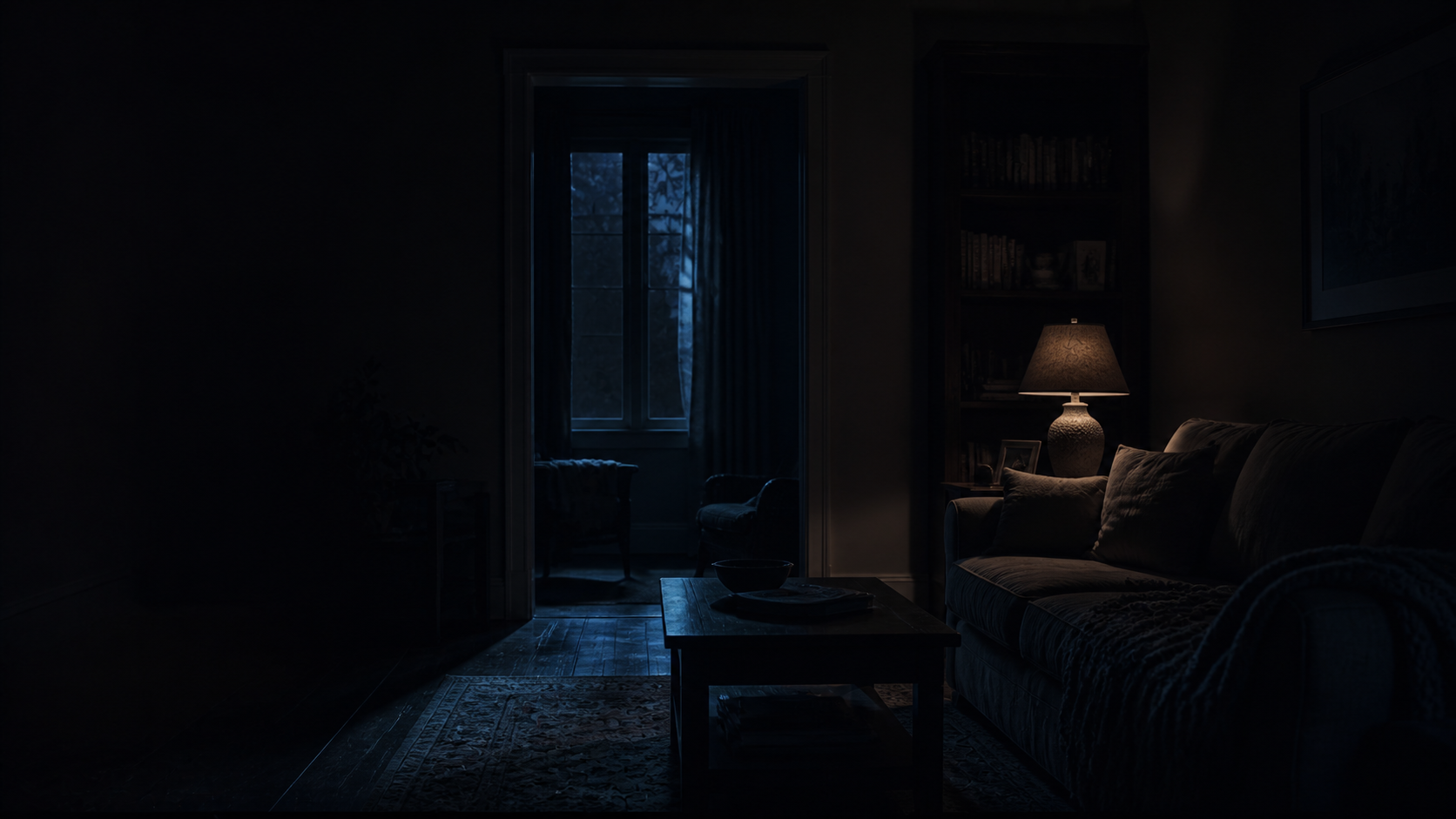
Why Familiar Rooms Feel Different at Night
The room has not changed, but the inputs your brain uses to build it are different after dark.
You have been in this room hundreds of times. You know where everything is. You know the sounds the building makes and the way the light falls. And then it is three in the morning, and you are standing in the same room, and it is not quite the same room. The furniture has the right shapes but seems too large or too close. The familiar sounds are the same sounds, but they have a different weight. Nothing has changed, and everything feels different.
Short answer: Familiar rooms feel different at night because the brain uses fundamentally different inputs to construct them. Lighting, sound, body state, and cognitive context all shift between day and night, and each shift changes how the room is perceived and processed. The room is the same. The perceptual system processing it is not.
The Room the Brain Builds
The experience of being in a room is not a simple recording of what is there. It is a construction — an active process in which the brain combines current sensory input with stored expectations, memory, and context to produce a stable, coherent experience of place.
In daylight, that construction is heavily supported. Good lighting provides rich visual detail. Familiar sounds from outside — traffic, birds, other people — locate the room in a recognizable context. The body is alert. Cognitive resources are available. The brain builds the room easily, with strong inputs, and the result is a place that feels solid, readable, and known.
At night, the inputs change. Light is reduced or different in quality. Outside sounds are absent or altered. The body is in a different physiological state — tired, or in the low-arousal state that precedes sleep, or heightened by the fact of being awake at an unusual hour. The brain is building the same room from different materials, and the room that results is not quite the same.
What Darkness Does to Spatial Perception
Visual depth perception relies on multiple cues that are diminished or absent in low light. Shadow gradients, texture detail, the parallax shift that occurs with head movement, the fine detail of surface texture — all of these contribute to the brain’s sense of where things are and how far away they are. In darkness, they disappear or degrade.
The result is a subtle but real distortion of spatial experience. Distances become harder to judge. The room can feel larger — or smaller — than it does in the daytime. Objects at the edge of visibility seem closer than they are, a well-documented perceptual effect of low-light conditions. The walls do not feel as definitively present.
This spatial uncertainty is not dramatic — you do not suddenly lose the ability to navigate a room you know. But it is real enough to produce a mild, pervasive unease. The room is not where it usually is, quite. The space is the same but does not feel scaled the same. The perceptual world is slightly off-register from the remembered one.
The Acoustic Profile of the Night Room
Rooms are acoustic spaces, and the sounds present in them contribute significantly to how they are experienced. In the daytime, background noise from outside — traffic, activity, weather, other people — creates a perceptual context that locates the room within a larger, inhabited world. The room is part of something ongoing.
At night, that context collapses. The outside noise drops. The room’s own sounds become audible in a way they are not during the day: the building settling, the HVAC cycling, the small sounds of objects cooling or contracting. These are the same sounds that are present in the daytime, but they are masked during waking hours and only emerge when the ambient noise floor drops.
Sounds that were always there, now audible for the first time, have no established place in your acoustic model of the room. They are unfamiliar. And the brain, receiving unfamiliar sounds from a space it thought it knew completely, treats them as information — possible signals of something it did not know about the room. The room sounds different because you are finally hearing it.
The Role of the Body in Perceiving Space
Perception is not a purely visual and auditory process. The body’s state contributes to how the world is experienced. Alertness, fatigue, heart rate, hormonal state — these all affect the quality and character of perception in ways that are well-documented but not always consciously noticed.
At night, particularly in the middle of the night, the body is in a different state than it is during the day. Cortisol levels are lower. Body temperature is typically slightly reduced. The circadian system is signaling that this is not the normal time for waking perception. If you are awake at three in the morning when you should be asleep, the perceptual system is running in a mode it was not optimized for.
In this state, sensory processing is subtly altered. The threshold for perceiving threat-relevant stimuli — movement, unusual sounds, ambiguous shapes — is lower. The brain is, in a sense, more cautious in the middle of the night, because night historically was the time when threats were most likely and least visible. That caution manifests as a heightened sensitivity to exactly the kinds of stimuli that make a familiar room feel unfamiliar.
Memory and the Day Version of the Room
The familiar room you remember is, in most cases, the daytime room. The memory was laid down in daylight, with full visual information, with the ambient sounds of normal waking hours. That memory is what the brain compares to current experience when it assesses whether a place is known or unknown, safe or uncertain.
The night room does not match that memory cleanly. The shapes are right, but the lighting is different. The sounds are right in some ways, but the acoustic texture is different. The spatial layout matches, but the felt distances are slightly off. Every small mismatch between the remembered daytime room and the perceived nighttime room is a signal that something has changed.
The brain does not naturally conclude: the room is the same, the conditions are different. It concludes: something is different about this room. The difference is real — it is just not located in the room itself.
| Daytime room | Nighttime room |
|---|---|
| Rich visual detail, clear spatial cues | Reduced visual input, uncertain distances |
| Ambient outside noise provides context | Silence isolates internal sounds |
| Alert body state, full perceptual resources | Low-arousal or sleep-adjacent body state |
| Room matches stored daytime memory | Room diverges from stored daytime memory |
| Baseline threat detection, neutral state | Heightened sensitivity, cautious mode |
Why the Night Version Feels More Real
There is something about the night version of a familiar room that many people describe as feeling more real, not less — more present, more physically immediate, more as if the room itself is exerting a kind of pressure. This seems paradoxical. The night room is a degraded version of the day room, running on worse inputs. Why would it feel more intense?
The answer is attention. In the night room, without the distractions of the day, without the ambient noise and the demands of normal waking life, the room has more of your attention. And more attention means more processing. Details that were filtered out during the day get noticed at night — the particular sound of the heating system, the way a reflection catches in a window, the exact quality of the dark in a corner.
More processing, in a system that is already running in a cautious mode, produces more signals. The night room generates more perceptual output than the day room, not less. It just generates that output in a mode that is oriented toward finding what is wrong, what is unusual, what does not match expectations. The intensity is real. The room is just being processed differently.
What the Night Room Is Actually Showing You
The familiar room at night is a demonstration of how much of normal perception is context-dependent — how much of what feels like simply seeing the room as it is involves the particular circumstances under which you are seeing it.
Lighting, body state, acoustic environment, circadian timing, the memory you are comparing against — all of these shape the room you experience. Change them, and you change the room, even though the room itself has not changed. The night version is not the true room, and neither is the day version. Both are constructions, built from the available inputs of the moment.
What makes the night room strange is that it reveals the construction process in a way the day room does not. In good conditions, perception is seamless. The room simply is. In poor conditions, the seams show. You can feel the brain working to assemble a familiar place from unfamiliar inputs, and the effort is exactly what the strangeness feels like.