Why Early Dinosaur Museums Got So Many Dinosaurs Wrong
The first museum dinosaurs were built from limited evidence, old assumptions, and visual habits that later fossils would overturn.
The dinosaurs in the earliest natural history museums were wrong. Not slightly wrong, not wrong in minor details — wrong in fundamental ways about posture, locomotion, anatomy, and behavior that seem obvious in retrospect but were invisible to the scientists who built them. The creatures that Victorian and Edwardian audiences lined up to see bore significant relationships to the animals they represented, and significant departures from them, in ways that took most of the twentieth century to fully understand.
Short answer: Early dinosaur reconstructions were wrong because paleontologists had incomplete fossils, no living analogues to guide them, and were unconsciously shaped by the animals they did know — large living reptiles, and their own cultural assumptions about what ancient life should look like. The errors were not failures of intelligence. They were failures of evidence, corrected as better evidence became available.
The Iguanodon's Thumb
The Iguanodon was one of the first dinosaurs to be formally described, named by Gideon Mantell in 1825 based on teeth found in England that resembled those of a modern iguana, scaled to enormous size. When more complete Iguanodon material was found in Belgium in 1878 — an extraordinary find of multiple nearly complete skeletons in a coal mine near Bernissart — scientists had far more to work with. But what they built was still wrong.
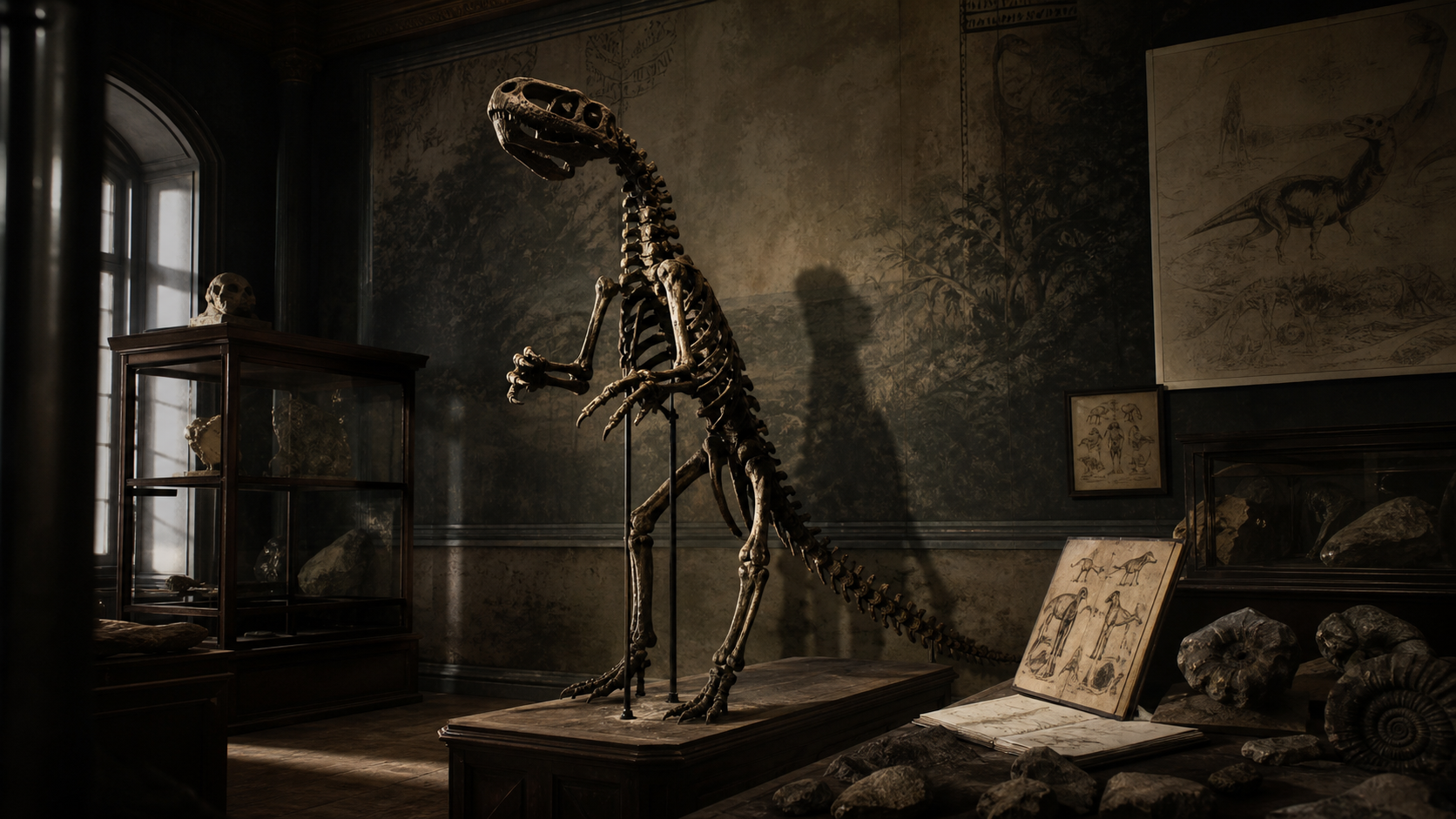
The Bernissart Iguanodons were mounted in the Royal Belgian Institute of Natural Sciences in an upright, kangaroo-like posture, tail dragging on the ground, body nearly vertical. This posture felt natural to scientists who were thinking of the animals as large, slow reptiles — giant versions of the living reptiles they knew, scaled up and made ancient.
Additionally, when the first Iguanodon remains were found, a conical bone was recovered that Mantell initially placed on the animal's nose as a horn, in the manner of a rhinoceros. It was later correctly identified as a thumb spike — a modified thumb bone used, probably, for defense or feeding. The animal had been given a nose that belonged on its hand.
The Tail-Dragging Problem
For most of the twentieth century, the default posture for large theropod dinosaurs — the group that includes Tyrannosaurus rex and its relatives — was upright and bipedal, with the tail dragging behind as a counterbalance. This posture was modeled partly on living large reptiles such as monitor lizards, and partly on the assumption that the tail was a passive counterweight rather than an active element of the animal's locomotion.
The tail-dragging posture was adopted partly because museum mountings in the nineteenth and early twentieth centuries physically rested the tail on the ground, providing a tripod of support for the standing skeleton. Once a mounting convention is established, it becomes the visual reference for subsequent reconstructions, illustrations, and public understanding. The dragging tail was self-reinforcing.
The evidence against it was present in the fossil record for decades before the correction was widely adopted. Dinosaur trackways — fossilized footprints made in soft sediment that hardened to stone — rarely show tail-drag marks. A tail-dragging animal of significant size moving through mud would leave a continuous central groove between the footprints. Most trackways show only footprints. The tails were being held up. It took until the 1970s and 1980s for the upright-tail, horizontal-body posture to become the new standard.
The Living Reptile Bias
Many early reconstruction errors can be traced to a single underlying assumption: that dinosaurs were essentially large lizards or crocodilians, and that living large reptiles were reasonable guides to extinct ones. This was not an unreasonable starting point in the mid-nineteenth century, when the relationship between different animal groups was less well-understood and the evolutionary connections between dinosaurs and living birds had not been established.
The living reptile bias produced reconstructions that were scaly, slow, cold-blooded, and low to the ground — because that was what large reptiles looked like. It produced behavioral assumptions — solitary, ectothermic, simple — that aligned with living reptile behavior. And it produced a visual language for dinosaurs that was essentially a scaling-up of the living reptile, with modifications where the fossil evidence made them unavoidable.
The correction of this bias began with the work of John Ostrom in the 1960s and 1970s, who argued based on detailed anatomical analysis that theropod dinosaurs were active, warm-blooded animals more similar in their physiology to birds than to crocodilians. Ostrom's work, and the work of his student Robert Bakker, produced what is sometimes called the Dinosaur Renaissance — a fundamental revision of scientific and popular understanding of what dinosaurs were like.
Feathers and the Last Great Correction
The most significant ongoing correction to the dinosaur image is the recognition that many dinosaurs — particularly theropods, the group most closely related to birds — were feathered. The evidence for this accumulated slowly through the latter decades of the twentieth century and then dramatically with a series of extraordinary fossil discoveries from Cretaceous deposits in Liaoning Province, China, beginning in the 1990s.
The Liaoning fossils preserved not only bones but soft tissue impressions, including feather imprints. They showed feathered dinosaurs at various stages of feather development, from simple filaments to complex pennaceous structures similar to those of modern birds. The evidence was unambiguous: many dinosaurs that had been reconstructed as scaly were feathered, or covered in feather-like structures, to a degree that changed their visual appearance entirely.
The famous image of Tyrannosaurus rex — a scaly, upright, tail-dragging predator — has been revised in the following ways: the tail is held horizontally, not dragging; the body is oriented more horizontally than vertically; and the question of whether it bore some feathering, at least in juveniles, remains scientifically open. The animal of popular imagination and the animal that actually existed are still, in some respects, in the process of converging.
| Early reconstruction error | When the correction came |
|---|---|
| Upright, kangaroo-like posture | 1970s-1980s; horizontal posture adopted |
| Tail dragging on the ground | 1970s; trackway evidence showed raised tails |
| Iguanodon nose horn | Re-identified as thumb spike in late 19th century |
| Scaly skin throughout | 1990s-2000s; feather evidence from Chinese fossils |
| Cold-blooded, slow metabolism | 1970s onward; warm-blooded physiology supported |
Why the Errors Lasted So Long
The persistence of incorrect dinosaur reconstructions across decades is not a story about scientists being stubborn or careless. It is a story about how knowledge advances under conditions of incomplete evidence. Every reconstruction is a hypothesis — an attempt to build the most likely animal from the available evidence. When the evidence is sparse, the hypothesis is heavily influenced by what the scientist already knows, which means it is heavily influenced by living analogues, cultural assumptions, and the visual conventions established by earlier reconstructions.
Revising a hypothesis requires new evidence that is inconsistent with the existing one and compelling enough to warrant the cost of revision. In paleontology, that evidence comes from new fossil finds, new analytical techniques, and new theoretical frameworks. All of these arrive irregularly and sometimes slowly. In the decades between major revisions, the current best hypothesis continues to be taught, illustrated, and exhibited — which is why the dragging-tailed, scaly, upright dinosaur remained the standard image for so long even as evidence against it accumulated.
What the history of dinosaur reconstruction reveals is not that scientists got it wrong, but that getting it right is a process rather than an event. The museums of the Victorian era built the best dinosaurs they could from the evidence they had. The museums of today are building the best dinosaurs they can from much better evidence. The museums of the future will correct things that current paleontologists are getting wrong without knowing it — because the evidence that will reveal those errors has not been found yet.