
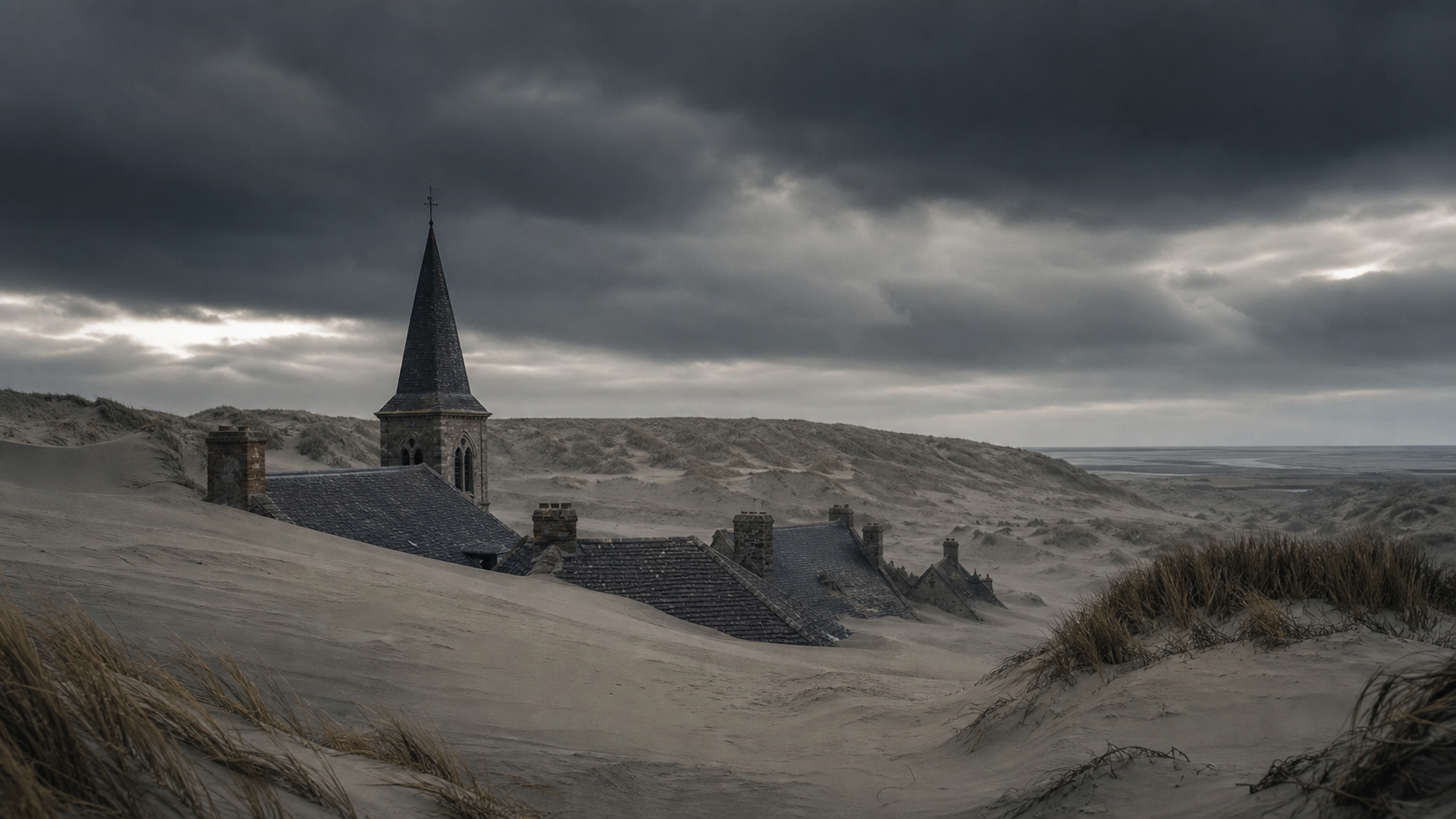
The Village Slowly Being Covered by Sand
Sand dunes are not static scenery. In the right places, they move slowly enough to watch and powerfully enough to bury settlements.
There is a village in the Netherlands that is being buried. Not by catastrophe, not by accident, and not all at once — but steadily, year by year, by the sand dunes that have been advancing across the landscape for centuries. Soesterberg? No. Hulshorst? Close. The village most associated with this phenomenon is Huisduinen, but the most dramatic and historically documented case is that of the Dutch coastal village of Petten, and the broader story of how shifting dunes have swallowed communities across northern Europe and the American coast alike.
Short answer: Sand dunes are not static. They move, driven by wind, and where they encounter settlements, they bury them — slowly enough that people can sometimes keep ahead of the advance, quickly enough that communities have been lost within living memory. The process is ongoing in multiple places around the world today.
How Dunes Move
A sand dune advances because of the way wind interacts with it. Wind picks up sand grains from the windward face of the dune — the side facing into the wind — carries them over the crest, and deposits them on the leeward face. The net effect is that sand is continuously removed from one side and added to the other. The dune itself travels in the direction the wind blows.
The speed of advance depends on the dune's size, the wind strength, and the presence or absence of vegetation. Bare dunes with no plant cover can move several meters per year. Larger dunes move more slowly, but their scale means that even slow movement delivers an enormous volume of sand. A dune fifty meters tall advancing two meters per year is burying two meters of whatever is in front of it with a wall of sand fifty meters high.
Vegetation stabilizes dunes by anchoring the sand with root systems and reducing wind speed at the surface. The removal of coastal vegetation — through overgrazing, land clearing, or simple disturbance — can destabilize previously fixed dunes and set them moving. Many historical dune advances were triggered by human activity that removed the stabilizing plant cover from coastal landscapes.
Skagen and the Church in the Sand
The most visually striking surviving example of a sand-buried structure in Europe is the Buried Church of Skagen in northern Denmark. Skagen sits at the very tip of the Jutland Peninsula, where two seas meet and where, historically, shifting sand dunes posed a continuous threat to settlement.
The church of Sankt Laurentii was built in the fourteenth century and was a substantial stone structure. By the eighteenth century, dune advance had made the surrounding area increasingly untenable. Sand drifted against the walls, buried the churchyard, and eventually made the building impossible to reach or maintain. The congregation abandoned it in 1795. By that point, sand had accumulated to the level of the church windows on the windward side.
The church was demolished in 1810, with the exception of the tower, which still stands — partially buried, visible above the dune surface, in a landscape of marram grass and white sand. It is now a tourist site, and the view of the tower emerging from the dune is one of the most photographed images in Denmark. The rest of the church lies beneath the dune, mostly intact.
The Culbin Sands, Scotland
In 1694, a large estate on the Moray coast of Scotland was buried by sand in what contemporary accounts describe as a rapid event following a series of severe storms. The Culbin estate — which had included a manor house, farm buildings, and cultivated land — was reportedly buried within days. The exact speed is disputed by later historians, but the result is not: by the early eighteenth century, the entire estate had vanished under what became known as the Culbin Sands.
For the next two centuries, the dunes were the largest mobile sand mass in Britain. Accounts from the eighteenth and nineteenth centuries describe chimney tops emerging from the sand in dry years and disappearing again. The estate was eventually stabilized by large-scale afforestation beginning in the 1920s, when the Forestry Commission planted millions of trees across the dunes. The Culbin Forest now covers the site. Nothing of the original estate is accessible.
Moving Dunes Today
Dune advance is not a historical problem that modern engineering has solved. It is an ongoing process in multiple places around the world, and in some locations it is accelerating due to changes in land use, vegetation loss, and shifting wind patterns associated with climate change.
In Mauritania, the capital city of Nouakchott has been expanding toward the desert while the desert has simultaneously been advancing toward the city. Sand management — barriers, plantings, mechanical removal — is a continuous operational requirement rather than a one-time intervention. In parts of China, entire villages have been relocated as dune systems that were previously stable have begun moving again.
The Dune of Pilat on the Atlantic coast of France, the tallest sand dune in Europe at over a hundred meters, advances inland at roughly two to five meters per year. A forest of pine trees on its eastern edge has been progressively buried over the past century. Photographs taken from the same vantage point across several decades show the treeline retreating as the dune moves through it. The trees do not fall — they are buried standing, killed by sand, and their trunks eventually emerge on the other side of the dune as the advance continues.
| Location | What the dunes buried |
|---|---|
| Skagen, Denmark | 14th-century church; tower still visible above dune |
| Culbin Estate, Scotland | Manor house and farm estate, buried 1694 |
| Dune of Pilat, France | Progressive burial of coastal pine forest |
| Nouakchott, Mauritania | Ongoing advance requiring continuous sand management |
| Great Plains, USA | Historic farms lost during 1930s Dust Bowl dune migration |
What Sand Burial Preserves
Sand is an unusually good preservative under the right conditions. It is dry, it is chemically inert, and it excludes the oxygen and moisture that drive most decay processes. Organic materials — wood, leather, fabric, food — that would decompose quickly in most burial environments can survive for centuries under dry sand.
The Buried Church of Skagen's lower walls and floor, the foundations of the Culbin manor house, and the preserved organic material found beneath various coastal dune systems all attest to this. Archaeological excavations at sand-buried sites routinely find organic materials in better condition than equivalent sites buried in soil. The sand that destroyed these settlements by burying them also, paradoxically, preserved them.
This means that the villages slowly being covered by sand are not simply being erased. They are being archived. In decades or centuries, when the dunes eventually move past them — as dunes always do, given enough time — what they leave behind will be a record of the moment the advance arrived. The sand does not distinguish between what it destroys and what it keeps.