
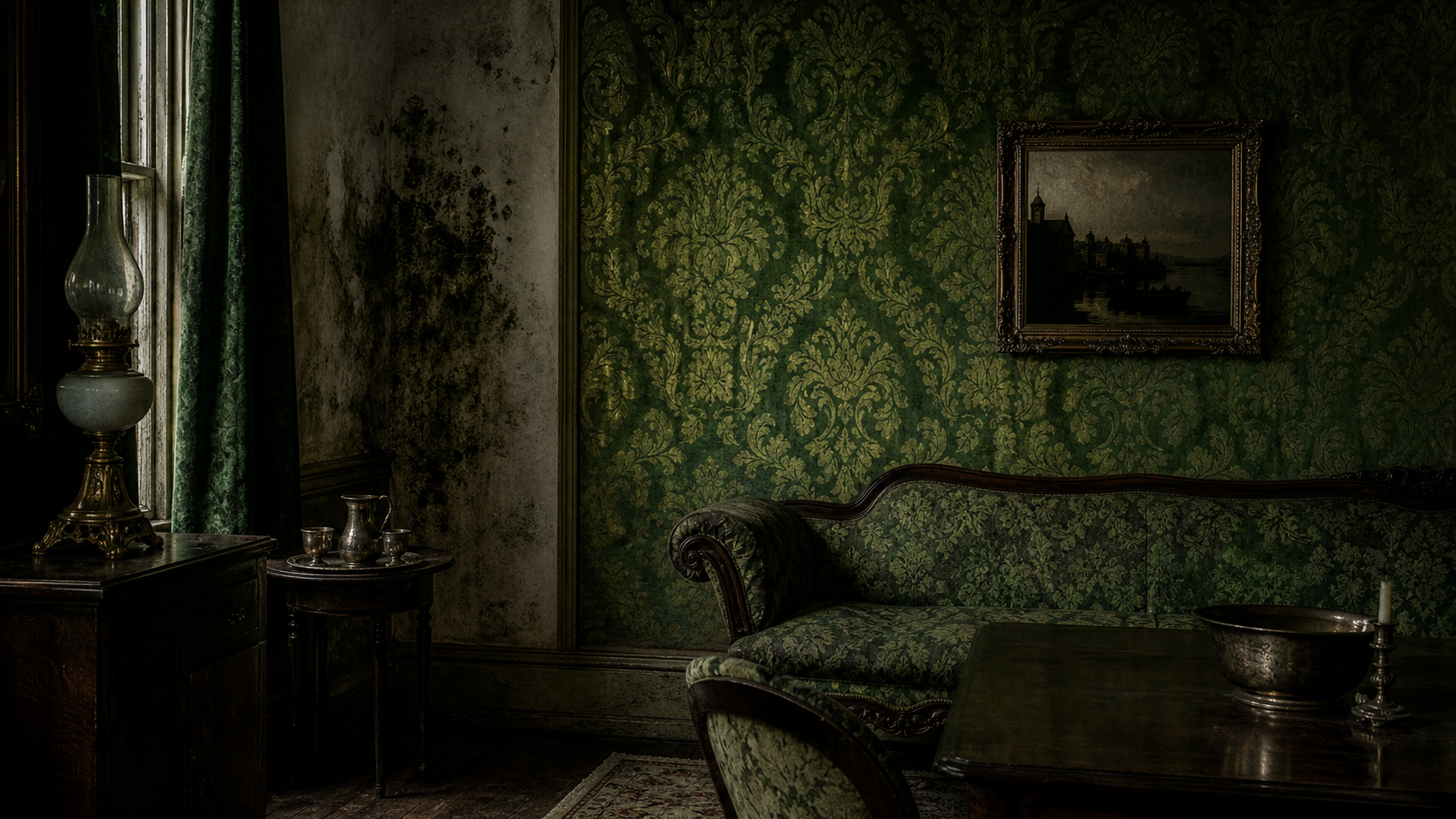
The Time People Feared Their Own Wallpaper
In Victorian homes, a fashionable green wall could be beautiful, modern, and quietly dangerous.
In the second half of the nineteenth century, an unusual pattern of illness was reported in households across Europe. The symptoms varied — headaches, nausea, fatigue, neurological disturbances — but the common factor, eventually identified after decades of investigation and denial, was the wallpaper. Specifically, the bright green wallpaper that was fashionable in Victorian homes, and the arsenic it contained.
Short answer: Victorian green wallpaper was colored with arsenic-based pigments, particularly a compound called Scheele's green and later Emerald green. In damp conditions, household mold metabolized the arsenic compounds and produced a toxic gas. The wallpaper that decorated fashionable homes was, in some cases, slowly poisoning the people who lived in them — and the industry denied it for decades.
The Color That Contained a Poison
The green that dominated Victorian decorating was not produced from plant pigments or other organic sources. It came from copper arsenite — a chemical compound synthesized from arsenic that produced a vivid, stable, affordable green unavailable from natural sources. Carl Wilhelm Scheele developed the first commercial arsenic-based green pigment in 1775. An improved version, Emerald green, appeared in the 1810s and became enormously popular.
Arsenic-based greens were used everywhere. Wallpaper was the most prominent application, but the same pigments appeared in fabrics, artificial flowers, book covers, children's toys, candles, food packaging, and the green felt of billiard tables. The pigment was trusted because it was effective and cheap, and because the dangers of arsenic poisoning in industrial settings were understood largely in terms of direct contact with the raw material, not in terms of the finished product.
The wallpaper was particularly problematic because of how it was manufactured. The green pigment was mixed with paste and applied to paper that was then sized — coated with a starchy compound — to fix the color. In damp rooms, mold grew readily on this starchy material. And some molds, it would eventually be shown, could convert inorganic arsenic compounds into volatile organic forms.
The Gas Nobody Could See
The mechanism by which arsenic-green wallpaper poisoned households was identified in 1893 by Italian chemist Bartolomeo Gosio, though the connection between green wallpaper and illness had been suspected for decades before that. Gosio demonstrated that the mold Scopulariopsis brevicaulis, growing on arsenic-containing materials, produced a garlic-smelling volatile compound — now known as trimethylarsine — that was toxic when inhaled.
The gas was produced when conditions were right: enough moisture to support mold growth, enough warmth to accelerate the biological process, and enough arsenic-containing material to provide substrate. Victorian rooms frequently met all three conditions. Poorly ventilated rooms with wallpapered walls in damp climates — which describes much of England for much of the year — were environments where the gas could build to harmful concentrations.
The symptoms of chronic low-level arsenic exposure through inhalation — fatigue, headaches, skin changes, neurological effects — were not distinctive enough to be reliably attributed to wallpaper by physicians unfamiliar with the mechanism. They overlapped with other common conditions. And the source of the illness was quite literally the decoration, which seemed too domestic and too beautiful to be the culprit.
The Industry's Response
The wallpaper and pigment industries did not receive the evidence of arsenic hazard with openness. The economic interests in arsenic-based pigments were substantial: the pigments were cheap, effective, and deeply embedded in the decorating trades. Manufacturers argued that the amounts of arsenic in finished wallpaper were too small to cause harm, that the illnesses reported were due to other causes, and that the evidence connecting wallpaper to illness was inconclusive.
This response was partly in bad faith and partly the result of genuine uncertainty. The science of occupational and environmental toxicology was not well-developed in the mid-nineteenth century. The causal chain from pigment to mold to volatile arsenic compound to human illness involved steps that were not obvious to contemporary medicine. Establishing causation required exactly the kind of controlled investigation that was rarely possible in domestic settings.
The British medical journal The Lancet ran articles raising concerns about arsenic in wallpaper as early as the 1850s. William Morris, one of the most celebrated wallpaper designers of the Victorian era, used arsenic-based greens extensively in his designs and publicly denied the health concerns despite the fact that his family's mining company was a major supplier of arsenic to the pigment industry. He continued using the pigments until the 1870s.
Famous Victims and Possible Cases
Napoleon Bonaparte died in 1821 on the island of Saint Helena. When a lock of his hair was analyzed in the twentieth century using techniques unavailable in 1821, it was found to contain arsenic at levels significantly above normal. The room he occupied on Saint Helena was papered with a green wallpaper. The hypothesis that Napoleon was slowly poisoned by his wallpaper — rather than by the deliberate poisoning that was sometimes suspected — gained significant traction in the 1990s, though the case remains debated by historians.
Other suggested cases include Clare Boothe Luce, the American playwright and diplomat, who experienced unexplained neurological symptoms while living in a green-painted bedroom in Rome in the 1950s. The cause in her case was eventually traced not to wallpaper but to arsenic-based paint on the bedroom ceiling, the dust of which fell onto surfaces she used daily. The mechanism was the same; the delivery was direct rather than via gas.
| Arsenic green product | Approximate period of use |
|---|---|
| Scheele's green wallpaper | 1775s-1880s |
| Emerald green fabric dye | 1810s-1890s |
| Arsenic-dyed artificial flowers | 1840s-1880s |
| Green book covers and playing cards | 1800s-1870s |
| Children's toy paints | Mid to late 19th century |
The Decline of Arsenic Green
The shift away from arsenic-based wallpaper pigments was gradual rather than abrupt. Public concern increased through the 1870s and 1880s as the evidence accumulated. Some manufacturers voluntarily switched to arsenic-free alternatives. The National Health Society in Britain produced arsenic-free wallpaper and promoted it explicitly as a safer alternative.
The development of synthetic aniline dyes in the second half of the nineteenth century provided alternatives to arsenic-based pigments that could produce equivalent colors more safely and, eventually, more cheaply. As these alternatives became available and commercially viable, the economic argument for maintaining arsenic-based production weakened.
By the 1890s, arsenic-based green pigments had largely disappeared from wallpaper production in Britain, though they persisted longer in other applications. The shift was driven by a combination of public pressure, regulatory interest, and the availability of safer alternatives — the same combination that drives most public health transitions. The wallpaper that had been fashionable, beautiful, and modern spent several decades being gradually recognized as something that had been slowly making people ill in their own homes.
What the Wallpaper Tells Us
The arsenic wallpaper episode is a useful case study in how consumer products can cause harm across decades without being identified, and in how industries respond to evidence that their products are harmful. The pattern — early warnings, industry denial, gradual accumulation of evidence, eventual withdrawal as alternatives become available — recurs across many later public health histories.
What makes the wallpaper case particularly striking is its setting: the domestic interior, the most controlled and supposedly safe environment in Victorian life. The harm was not in the factory, the mine, or the street. It was in the drawing room, the nursery, the bedroom. The beautiful green that made a room feel finished and fashionable was the source of the danger. The intimacy of that — the decoration doing the damage — is what makes it feel, even now, stranger than it should.