
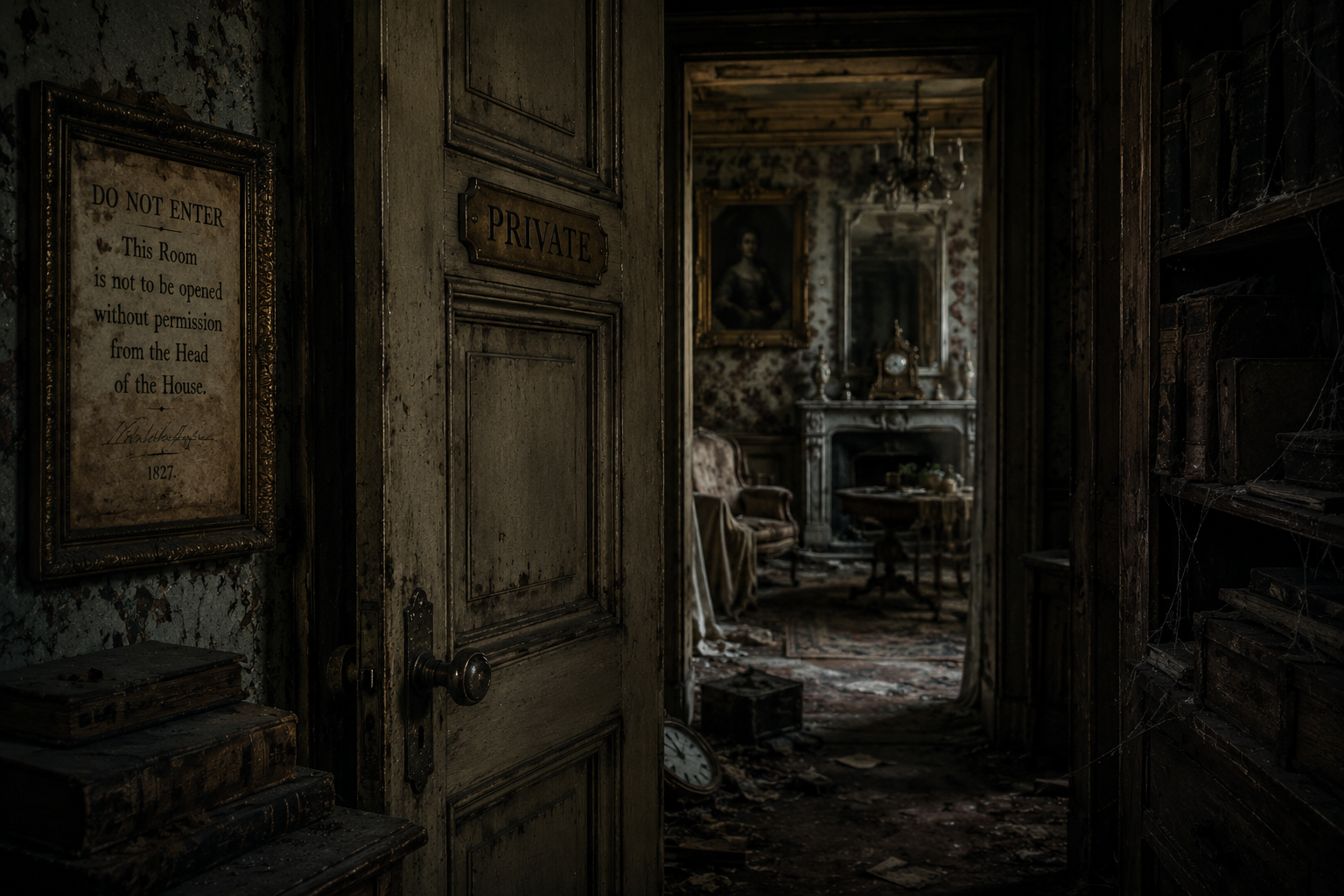
The Strange History of Locked Rooms Nobody Opened
History is full of rooms that were sealed, locked, or simply left alone for decades — sometimes centuries — and eventually opened to reveal what had been left inside.
Some locked rooms were sealed deliberately. Some were forgotten. Some were left out of grief, or secrecy, or superstition. And some were left for reasons that were never recorded, and so remain genuinely unknown.
Short answer: Locked rooms that go unopened for long periods exist across history and across the world. The reasons vary — mourning, legal disputes, religious custom, fear, or simple neglect — but the pattern is consistent: something was put away, and then left, and the act of not opening became its own tradition.
When not opening becomes the habit
There is a logic to not opening a locked room that is easy to underestimate. At first, a door stays closed for a reason: the person who lived there has died, a legal case is unresolved, the contents are too painful to face. A week passes. A month. A year. By then, the act of not opening has become the established pattern. To open the room would require a decision, an effort, a confrontation with whatever is inside. Not opening requires nothing.
This is how rooms that were sealed in grief become rooms sealed by inertia. And inertia, applied over enough time, can last for generations. A room that one person chose not to open becomes a room that the next generation simply inherited as a closed room, without a clear mandate to do anything about it.
The sealed rooms of grand houses
Large private homes — particularly those that remained in the same family for multiple generations — have produced the most documented examples of long-locked rooms. A common pattern involves the room of someone who died young or suddenly: a child, a spouse, a sibling. The room was sealed shortly after the death, and then simply… not reopened.
In some cases, the sealed room became a kind of private memorial. The family maintained it without entering it, and it passed from owners to heirs as an established fact about the house. Eventually, decades later, someone opened it — either because the house was sold, or an estate was settled, or a renovation made the room impossible to avoid — and found everything as it had been left.
The Château de la Mothe-Chandeniers in France is one documented example: a room discovered during twentieth-century restoration that had not been opened since the nineteenth century, with personal effects still arranged as though the occupant had stepped out temporarily. There are documented examples in England, Ireland, Germany, and across the American South, in plantation houses and urban townhouses alike.
Institutional sealed rooms
It is not only private homes where rooms go unopened. Universities, hospitals, and government buildings have all produced versions of this story. A storage room sealed during a renovation project and not reopened for eighty years. A wing of a hospital locked during a disease outbreak and never formally recommissioned. An office in a university building that was locked after a professor left and somehow never reassigned.
These institutional examples tend to have a different character from domestic ones. The contents are less personal — filing cabinets, equipment, furniture — but the effect of time is just as significant. Things that were current when the room was sealed have become antique. Technologies that were cutting-edge have become obsolete. Documents that were unremarkable have become historical records.
Several university libraries have discovered sealed storage areas containing first editions, rare manuscripts, and early printed materials that had been locked away during building reorganizations in the early twentieth century and simply not rediscovered for seventy or eighty years.
What makes institutional rooms strange: they are often not sealed by emotion, but by paperwork, renovation, or neglect — yet time gives them the same preserved, uncanny quality.
Rooms sealed by legal dispute
Legal complications have produced some of the most bizarre long-closed rooms on record. When a property is caught in a legal dispute — a contested will, an unresolved boundary case, a bankruptcy — the contents may be sealed by court order and left untouched until the case is resolved. Some cases take years. Some take decades.
The legal sealing of contested estates has produced documented rooms where nothing was touched for twenty, thirty, or forty years while the courts slowly worked through the relevant questions. When the rooms were finally unsealed, they contained not just the original contents but a record of the moment the dispute began: newspapers from the relevant year, perishable goods long since decomposed, clocks stopped at whatever hour the seal was applied.
Religious and ritual closings
Some rooms were sealed for explicitly spiritual or ritual reasons. In certain religious traditions, a room where someone died would be closed for a prescribed mourning period. In others, objects associated with the deceased were sealed away so they could not be used by the living. In a few documented cases, rooms were sealed because something was believed to have happened inside them that made them unsafe — not physically, but in a more diffuse sense that combined grief, guilt, and superstition.
These ritual closings could last for a generation or longer. The original reason would fade, but the habit of not entering would remain. Children who grew up in these houses learned that certain doors were not to be opened. They passed this knowledge to their own children, without always being able to articulate why.
| Reason for sealing | How long rooms typically stayed closed |
|---|---|
| Grief after a death | Decades; sometimes across generations |
| Legal dispute or estate contest | Duration of the legal case, sometimes 20–40 years |
| Institutional neglect or reorganization | Often 50–80 years before rediscovery |
| Religious or ritual custom | Variable; sometimes permanently |
| Unknown or forgotten reason | Indefinite |
What gets found inside
The contents of a long-sealed room depend on what was in it and how well-sealed it actually was. Perfectly sealed rooms are rare — most allow some air circulation, and with air comes moisture, insects, and the slow work of decay. Paper deteriorates. Fabric rots. Food becomes unrecognizable.
What tends to survive is what is made to last: metal, glass, ceramics, stone. Books survive if the conditions were dry enough. Furniture survives structurally, even when the upholstery has collapsed. Photographs survive if they were stored away from light.
The effect of opening a sealed room is partly the visual impact of what has survived and partly the inventory of what has not. The gap between these two — the objects that remain and the objects that are now only suggested by their decomposed traces — tells a story about time passing in a place where, for the people outside it, time felt suspended.
Why we keep being fascinated
The sealed room holds an obvious narrative appeal. It is a place of interrupted time — a space that was frozen at a specific moment and then left to its own slow processes while the world outside continued. The appeal is partly the same one that draws people to time capsules and archaeological sites: the idea that the past has been preserved, that something of what was there is still recoverable.
But the sealed room carries something extra. It was sealed by a person, for reasons that mattered to them. It is not an accidental preservation. It is a deliberate one, however irrational or grief-driven it might have been. And behind every locked door that nobody opened for fifty years is a human story that the door itself cannot tell.
Opening it answers some questions and generates others. What you find inside is rarely everything you were looking for.
But it is always, in some way, more than you expected.