
The Object in Your Kitchen With a Strange Origin
The familiar objects in a kitchen drawer preserve centuries of rejection, delayed invention, and domestic change.
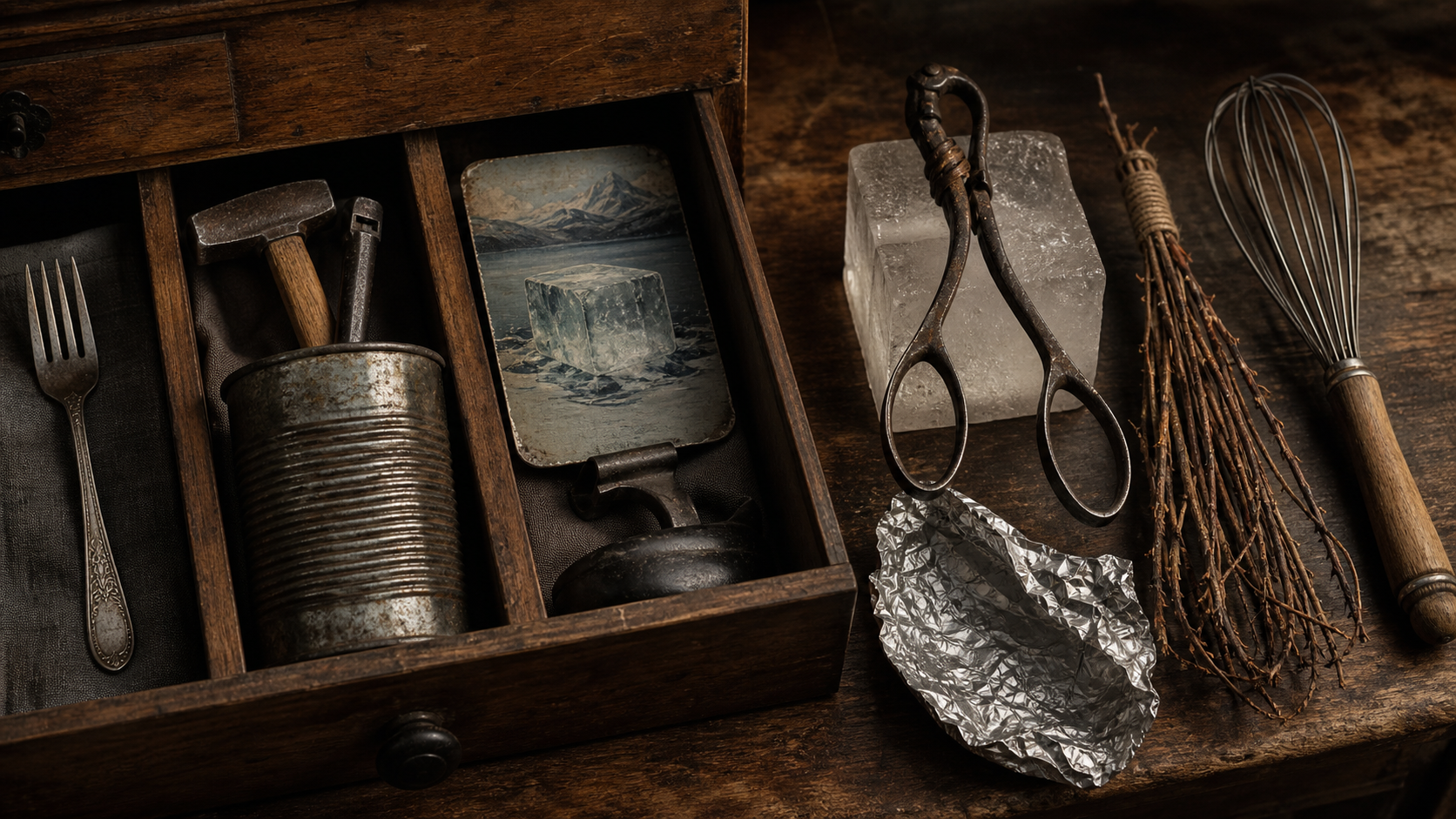
The kitchen is the room most associated with the domestic and the familiar. The objects in it feel like they have always been there, in their current form, doing their current jobs. Most of them have not. The fork sitting in the drawer went through centuries of ridicule before it was accepted. The refrigerator replaced a system that was far stranger. And the humble can opener arrived forty-eight years after the can it was designed to open.
Short answer: Almost every common kitchen object has an origin that is stranger, more contested, or more recent than it appears. The design that feels inevitable usually took decades or centuries to settle, and the path there was rarely direct.
The Fork and Its Long Rejection
The table fork — a utensil so basic that its absence is now difficult to imagine at a formal meal — was considered unnatural, effeminate, and even ungodly for much of its early history in Western Europe. Forks existed in the ancient world as cooking implements and large serving tools, but the small personal fork used for eating was introduced to Western Europe from the Byzantine court and met with strong resistance.
When the Byzantine princess Theodora Doukaina brought forks to Venice in the eleventh century, her use of them at the table was reportedly condemned by a local clergyman as an insult to God's provision of fingers for eating. In England, the fork remained uncommon and slightly suspect until the seventeenth century. Thomas Coryat, who encountered forks in Italy and began using one in England around 1611, was mocked for the affectation.
The fork's gradual adoption was tied partly to changing ideas about cleanliness and refinement, partly to the increasing social complexity of formal dining, and partly to changes in the food being served — as meat was increasingly presented pre-cut rather than in large pieces that required tearing. The object that now signals basic table manners spent several centuries being considered a sign of effete foreign influence.
The Can and the Missing Opener
The tin can was patented in 1810 by merchant Peter Durand, who adapted a French method of food preservation in sealed containers for industrial application. Canned food was adopted quickly by militaries and expeditions for whom long-term food storage was essential. The cans of this era were heavy-gauge tin, sometimes soldered with lead, and the instructions on early cans sometimes suggested opening them with a hammer and chisel.
The can opener — a device specifically designed to open cans — was not patented until 1858, forty-eight years later. During those intervening decades, cans were opened with whatever was available: knives, bayonets, rocks. The design of the can in this period assumed the user would have access to tools, not that the container would come with any means of opening itself.
Even after the can opener was invented, it took further decades for the rotary wheel design now standard to appear. The first openers were simple pointed levers that required significant effort and skill. The familiar butterfly handle and rotating wheel design emerged in the 1920s. The electric can opener appeared in 1931. The object that now seems obvious took over a century from the invention of its associated container to reach approximately its current form.
The Refrigerator's Strange Predecessor
Before mechanical refrigeration became available to domestic consumers, food preservation in middle-class households relied on the icebox — a cabinet insulated with various materials and cooled by a large block of ice placed in an upper compartment. The ice melted slowly, keeping the interior cold, and needed to be replaced regularly.
The ice itself was harvested from frozen lakes and rivers in winter and stored in insulated ice houses, sometimes packed in sawdust, for sale throughout the year. In the nineteenth century, ice harvesting was a significant industry in northern regions, with ice shipped by boat and rail to cities as far south as the Caribbean. Frederic Tudor, known as the Ice King, built a fortune shipping New England lake ice to tropical markets beginning in the 1830s.
The ice route into a kitchen icebox was therefore: natural freezing of a lake in winter, harvesting by hand, transportation to an ice house, sale to a distributor, delivery by horse-drawn cart to the household, and placement by an iceman who came two or three times a week. The refrigerator replaced not just a different technology but an entire supply chain and the labor it involved. The humming box in the corner of the kitchen represents the disappearance of an industry that once employed thousands of people.
The Whisk and the Question of What Came Before It
The whisk — a bundle of loops of wire used to incorporate air into liquids and emulsify mixtures — is such a simple object that its pre-existence seems self-evident. Before the whisk, mixtures were beaten with bundles of twigs, reeds, or peeled birch branches bound together. The principle is identical to the modern whisk; the material is different.
The twig bundle was used across multiple cultures and is documented in European kitchens well into the nineteenth century. The wire whisk, in something approaching its current form, appears in French kitchen manuals of the mid-nineteenth century. The transition from twig to wire was gradual and regional: twig bundle whisks continued in use in rural areas long after wire versions were available.
What the whisk's history illustrates is that kitchen tool evolution is less often about the invention of a new principle and more often about the refinement of a material solution to a principle that was already understood. The twig bundle and the wire whisk are the same tool. The difference is efficiency, durability, and ease of cleaning — all of which are significant but none of which represents a conceptual innovation.
| Kitchen object | Strange fact about its origin |
|---|---|
| Table fork | Mocked and condemned for centuries; considered ungodly |
| Tin can | Existed for 48 years before a purpose-built opener was invented |
| Refrigerator | Replaced an industry that harvested and shipped natural lake ice |
| Whisk | Direct descendant of bound twig bundles used for millennia |
| Aluminium foil | Replaced tin foil; tin foil itself replaced waxed paper |
What Kitchen Objects Preserve
The kitchen objects that have survived into the present — fork, knife, whisk, pot, bowl — have done so because they solve problems that have not changed: cutting, mixing, containing, applying heat to food. The solutions have been refined, the materials have been updated, and the manufacturing has been industrialized. But the underlying function is often ancient.
This is why kitchen objects are such good archives of human history. The fork that was once foreign and suspect is now universal. The can that once required a hammer to open now has a pull tab. The icebox that required a regular delivery of frozen lake water has been replaced by a machine that generates its own cold. Each of these transitions records a change not just in technology but in how domestic life was organized, who did the work, and what counted as convenience.
The objects in the kitchen drawer feel obvious because they have had a long time to become obvious. Under that obviousness is a history of rejection, accident, delayed invention, and the slow convergence of material possibility and human need that produced the specific form each object now has. The kitchen is one of the most historically layered rooms in any home. It just rarely looks like it.