
Why the T. rex Bite Was So Terrifyingly Powerful
The T. rex bite was not just strong. It was a whole skull-and-tooth system built to crush bone.
Tyrannosaurus rex had the most powerful bite of any land animal that has ever lived. This is not hyperbole or a claim made in the absence of data. It is a figure that has been calculated, refined, and supported by multiple independent lines of evidence — fossil bone damage, skull biomechanics, tooth morphology, and comparative analysis with living animals. The number that emerges from these studies is large enough to require a moment to absorb: bite forces in the range of six to twelve thousand pounds of force, with some estimates running higher, depending on the method and the part of the jaw analyzed.
Short answer: T. rex's bite was powerful because of an unusual combination of features that evolved together: an enormous skull with thick, robust bones; jaw muscles that were large in absolute terms and arranged to maximize force rather than speed; and teeth designed not to slice but to puncture and crush — to destroy bone rather than avoid it. The animal was not built to kill quickly. It was built to process carcasses completely, and the bite is the key to understanding what it actually was.
The Numbers and What They Mean
Bite force estimates for T. rex vary depending on the method used to calculate them. Biomechanical modeling of the skull — using the size and attachment points of jaw muscles inferred from bone scarring and comparison with living relatives — produces estimates in the range of eight thousand pounds of force for the back teeth. Studies based on the damage observed in actual fossils — crushed and scored bones found in T. rex feeding sites — support figures in a similar range.
For comparison, the saltwater crocodile, which holds the highest measured bite force of any living animal, produces approximately three thousand seven hundred pounds of force. A large great white shark produces around four thousand pounds. The spotted hyena, long recognized as one of the most powerful biters among mammals relative to its size, produces around one thousand one hundred pounds. T. rex, at the high end of estimates, was generating roughly three times the force of the most powerful living biters.
These numbers refer to force at the back teeth — the molariforms, positioned far back in the jaw where mechanical advantage is greatest. At the front teeth, the force was lower, as is the case with all animals with long jaws. But T. rex's front teeth were themselves unusually robust, and they were doing different work than the back ones, as the tooth morphology makes clear.
The Architecture of the Skull
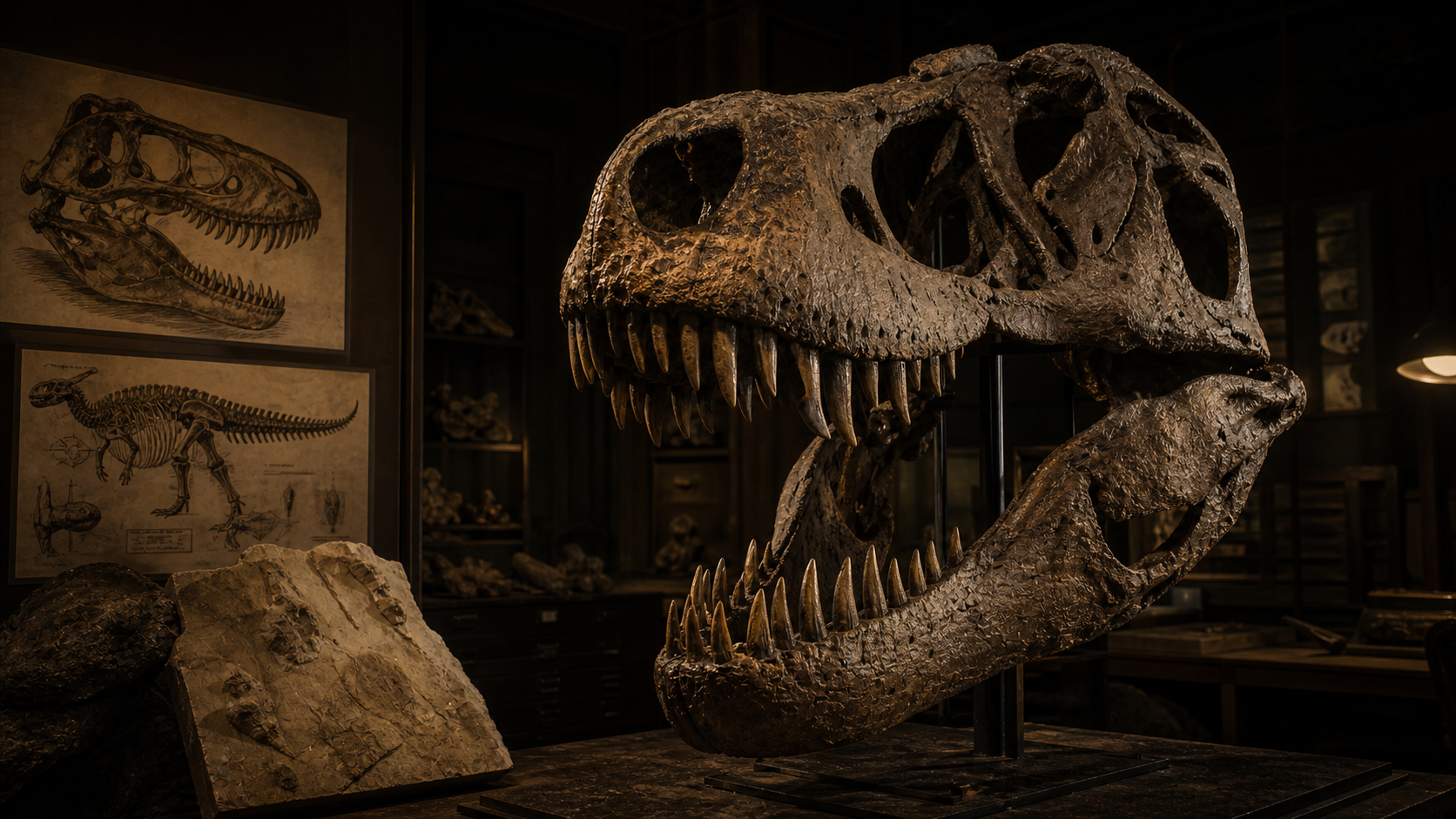
The T. rex skull is not just large. It is specifically built for the transfer of enormous forces without structural failure. The bones are thick, heavily reinforced, and arranged in a way that distributes stress across the skull rather than concentrating it at any single point. The kinesis — the slight flexibility that many reptile skulls have between their bony elements — is greatly reduced in T. rex compared to most other theropods, producing a skull that acts more like a rigid block than a flexible framework.
The temporal region of the skull — the area housing the primary jaw muscles — is massively developed. The adductor muscles that close the jaw attached to a broad, heavily scarred surface on the top and sides of the skull, and their size can be estimated from the size of this attachment area. In T. rex, these muscles were enormous in absolute terms, and their fiber arrangement was oriented to prioritize force over speed of closure.
The lower jaw is correspondingly reinforced. The dentary — the tooth-bearing bone of the lower jaw — is deep and thick. The joint between the lower jaw bones is fused or tightly sutured rather than flexible. The whole assembly is built to resist the forces generated in both directions: the force of biting down, and the reactive force of whatever is being bitten pushing back.
The Teeth and What They Were Built to Do
T. rex teeth are unlike those of most other large theropod dinosaurs. Most theropods had laterally flattened, blade-like teeth with serrated edges — structures adapted for slicing through flesh efficiently. T. rex teeth are banana-shaped in cross-section: oval, thick, with reduced serrations on the edges rather than fine blade serrations. They look more like railroad spikes than like steak knives.
This tooth shape is not optimal for slicing. It is optimal for puncturing and crushing — for driving through resistant material without the blade snapping. The material T. rex teeth were designed to drive through was bone. Multiple lines of evidence support this: bite marks found on T. rex prey fossils consistently show deep punctures and scoring consistent with the oval tooth cross-section; complete tooth punctures through thick bone have been documented; and fragmentary bone material has been found in T. rex coprolites — fossilized feces — indicating that T. rex was routinely ingesting and digesting bone.
No other large theropod is known to have done this. The shift from slicing teeth to crushing teeth in the tyrannosaur lineage represents a fundamental change in feeding strategy — from efficient flesh removal to complete carcass utilization, including the nutritionally dense marrow inside bones that other predators could not access.
Ontogeny: How the Bite Changed as T. rex Grew
T. rex was not born with its adult skull morphology. Juvenile tyrannosaurs had a different skull shape — narrower, with blade-like teeth more similar to those of other theropods. The robust, wide skull with crushing teeth was a feature of adult animals. This has led some researchers to propose that juvenile and adult T. rex occupied different ecological roles: juveniles as fast, agile predators taking different prey with slicing teeth; adults as bone-crushing, high-force specialists.
This ontogenetic shift — the change in skull morphology, tooth shape, and inferred feeding behavior as the animal grew — is unusual and has been the subject of considerable research. It suggests that T. rex's ecological role was not fixed throughout its life but changed substantially as it matured. The teenager and the fully grown adult were, in some functional respects, different animals occupying different positions in the food web.
The growth rate of T. rex was itself extraordinary. Analysis of bone tissue shows that T. rex grew at rates comparable to large modern mammals rather than modern reptiles — gaining several kilograms per day during peak growth phases. An animal that grew that fast needed to process enormous quantities of food, and a bite capable of accessing bone marrow — one of the highest-calorie foods available in a carcass — would have been a significant advantage.
The Mechanics of the Bite in Action
Understanding the bite force number requires understanding how the bite was actually used. T. rex was not a precision predator in the manner of a modern big cat, which targets specific soft-tissue kill sites to incapacitate prey quickly. The skull architecture and tooth morphology suggest a different strategy: powerful, bone-crushing bites applied to the body of the prey animal, generating massive tissue damage and bone fractures that incapacitated through injury and blood loss rather than through precise targeting of vital structures.
The evidence for this is found in healed bite wounds on potential T. rex prey. Several Triceratops and Edmontosaurus specimens have been found with healed bite wounds consistent in size and shape with T. rex teeth — meaning the prey animal survived the initial bite and lived long enough for the bone to begin healing. This indicates that T. rex bites were survivable at least sometimes, which in turn indicates that the bites were not always instantly lethal. They were damaging, disabling, and eventually fatal — but not necessarily instantaneous.
The comparison to hyenas is instructive here. Modern spotted hyenas are bone-crushing specialists with bite forces high enough to crack the femurs of large ungulates and access the marrow. They are also well-documented scavengers that feed from carcasses other predators have killed. T. rex, with its bone-crushing dentition and extreme bite force, has been proposed to have occupied a similar ecological position — not purely a predator, but an animal whose unique ability to process carcasses completely, including the skeletal elements other predators left behind, gave it a feeding niche that no other animal in its ecosystem could access.
| Animal | Estimated bite force | Relative to body |
|---|---|---|
| T. rex (adult) | ~8,000-12,000 lbs force | Extreme — highest of any land animal |
| Saltwater crocodile | ~3,700 lbs force | Highest of living animals |
| Great white shark | ~4,000 lbs force | High — cartilaginous skull helps |
| Spotted hyena | ~1,100 lbs force | Highest relative to size among mammals |
| Lion | ~650 lbs force | Moderate — optimized for suffocation hold |
The Arms and the Bite: A Connected System
T. rex's famously small forelimbs have long been a subject of speculation and mild ridicule. They are proportionally tiny relative to the animal's body, too short to reach the mouth, and apparently limited in their functional range. But their size may be directly connected to the power of the bite in a way that makes evolutionary sense.
In most large theropods, the forelimbs are used to grip and restrain prey while the jaws deliver killing bites. A large forelimb with powerful muscles requires space for those muscles, particularly around the shoulder and chest. In T. rex, the reduction of the forelimbs may have freed up space and resources for the expansion of the jaw muscles — which attach to the skull and require a large, unobstructed skull architecture to reach their full size.
If the forelimbs were reduced as part of a shift toward jaw-dominant prey processing, their small size is not a vestigial leftover or a developmental quirk. It is part of the same evolutionary package as the wide skull, the thick teeth, and the enormous bite force — a suite of features that evolved together to produce an animal whose primary processing tool was its mouth, not its hands.
What the Bite Tells Us About the Animal
The extraordinary bite force of T. rex is not just a striking number. It is a window into what kind of animal T. rex was and what ecological role it occupied. An animal with a bite built for bone-crushing rather than flesh-slicing, with teeth shaped for puncture rather than cutting, with a skull reinforced to resist the reactive forces of crushing resistant material — this is an animal that was not primarily a speed predator hunting through pursuit and precise killing. It was a high-force processing machine, capable of utilizing food resources that other large predators could not access.
This does not make T. rex less formidable. It makes it formidable in a different way — not the lean, fast, precision predator of some portrayals, but an animal of enormous power and biomechanical specialization, occupying an ecological niche built around the complete consumption of large carcasses in an ecosystem where that niche was valuable enough to sustain an animal of its size.
The bite force is the most dramatic single expression of a set of adaptations that redefined what a large predatory dinosaur could be. Understanding it requires understanding not just the mechanics but the ecology — what T. rex was eating, how it was processing that food, and why an animal that could crush bone had a significant advantage in a world full of very large things that eventually died and needed to be consumed completely. The number is impressive. What it means is more impressive still.