
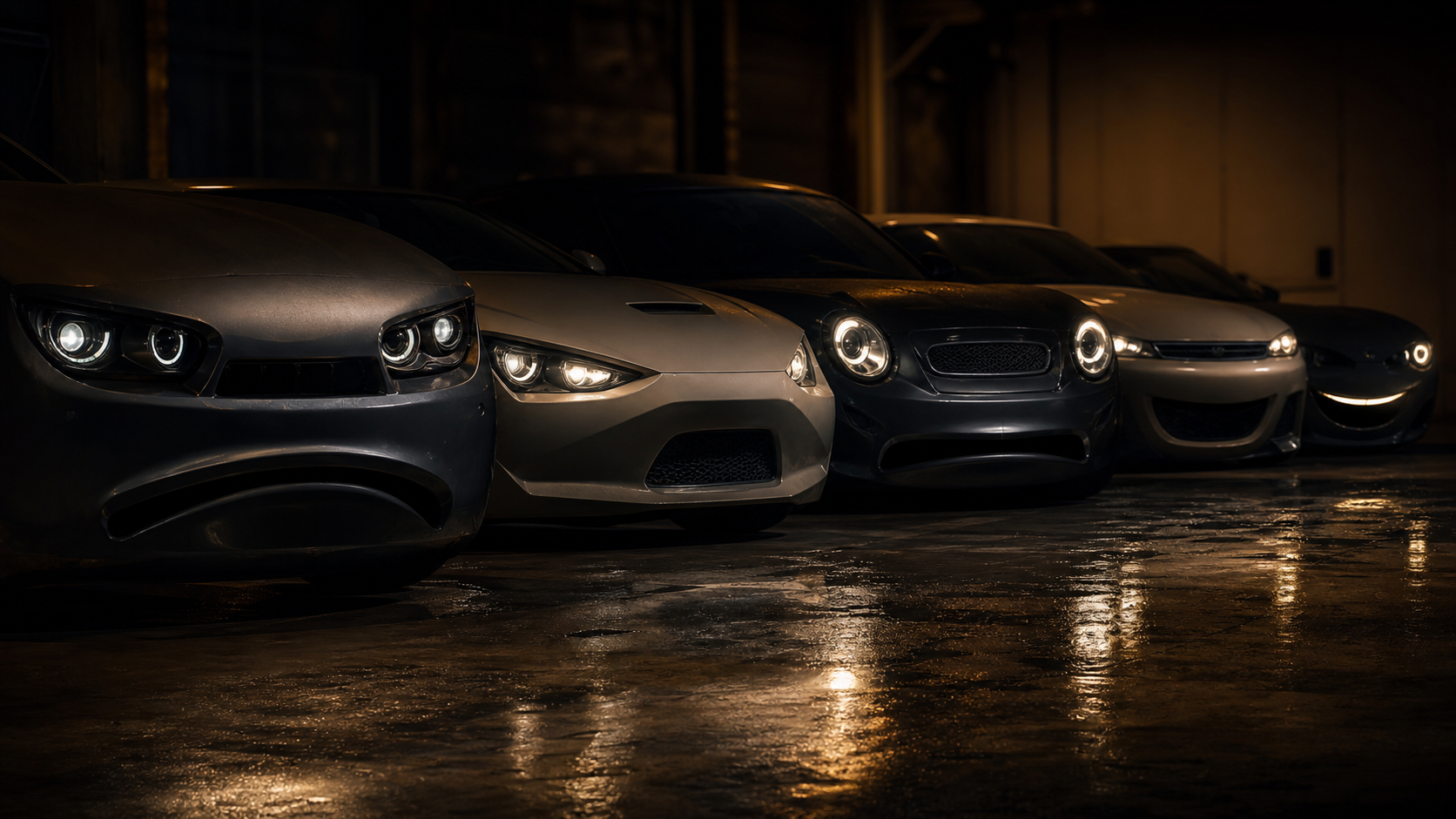
Why Some Cars Look Like They Have Faces
Headlights, grilles, and bumpers line up in a pattern the brain reads as a face, complete with mood.
You have noticed it without necessarily noticing that you noticed it. Some cars look friendly. Some look aggressive. Some look worried, or smug, or vaguely sleepy. The front of a vehicle — headlights, grille, the lower bumper line — arranges itself into something that the brain insists on reading as a face. And the face seems to have a mood.
Short answer: Cars look like they have faces because the brain's face-detection systems are triggered by the arrangement of headlights, grilles, and bumpers into a pattern that matches the face template: two marks above, one mark below, in rough bilateral symmetry. The effect is not accidental — car designers are aware of it and use it intentionally. The mood the face seems to project is real, because the same cues that signal emotion in human faces also signal emotion in face-like objects.
The Pareidolia of the Road
Pareidolia — the perception of meaningful shapes, especially faces, in random or ambiguous stimuli — is the underlying mechanism. The brain's face-detection system is calibrated to find faces quickly, to flag even weak face-like patterns as potentially significant, and to extract social information from them as soon as they are detected.
Car fronts provide a strong face-like stimulus. Headlights correspond to eyes, positioned symmetrically on either side of a central axis. The grille or lower bumper corresponds to a mouth, positioned below. The body of the vehicle provides the head-like frame. The pattern is not identical to a human face — the proportions are different, the elements are functional rather than biological — but it is close enough to trigger reliable face detection in most observers.
This is not a subtle effect that requires suggestion. Most people, shown photographs of car fronts without being asked to look for faces, spontaneously report perceiving facial expressions. The effect is stronger with some car designs than others, but it is present across most vehicles simply because most vehicles have headlights and a grille, and that combination is reliably face-like.
What the Headlights Are Doing
Headlights are the most face-critical element of a car's front end. They correspond to eyes, and eyes are the site of most emotional information in faces. The shape, size, angle, and position of headlights therefore largely determine what kind of face — and what kind of expression — the car's front presents.
Wide, round headlights produce an expression of surprise or innocence — the same association applies to wide eyes in human faces. Narrow, angled headlights produce an aggressive or focused expression. Headlights that angle down toward the center of the car produce a furrowed-brow effect that reads as anger or determination. Headlights that angle upward toward the center produce the opposite — an expression closer to surprise or friendliness.
Car designers are aware of this explicitly. The emotional character intended for a vehicle is often established first through the headlight design. An aggressive sports car gets narrow, angled headlights. A family-oriented vehicle gets larger, rounder ones. The face that results is intentional, because the designer knows the face will be perceived and responded to whether or not it is intended.
The Grille as Mouth
The grille corresponds to the mouth in the face template, and like the mouth in a human face, it contributes significantly to the perceived expression. A wide grille with a slightly upward curve reads as a smile — or at least as a non-threatening expression. A narrow, straight grille reads as neutral. A grille with downward elements — bumper lines that turn down at the corners — reads as a frown.
The size of the grille also affects perception. Very large grilles, occupying a substantial portion of the lower face of the vehicle, produce expressions that can read as aggressive or domineering — the face equivalent of a wide, open mouth. Smaller grilles produce more neutral or reserved expressions.
Some manufacturers have made the grille the primary identity element of their brand. BMW's twin-kidney grille, Audi's single-frame grille, and the large, prominent grilles on many American SUVs are as much about the face they produce as about any functional requirement for airflow. The face is a brand element.
Why Car Faces Have Gotten Angrier
Automotive design researchers have noted a consistent trend across the last few decades: car faces have become more aggressive. Headlights have narrowed and angled more sharply. Grilles have become larger and more dominant. The overall front-end design of many vehicles has moved away from the rounded, somewhat friendly faces of midcentury design toward expressions that read as assertive, aggressive, or threatening.
This shift appears to reflect both changes in consumer preference and deliberate design strategy. Studies show that people associate aggressive-looking cars with power, performance, and status. In a competitive market, a car that looks like it could dominate the road signals attributes that many buyers find appealing. The face is doing marketing work.
The same studies find, however, that aggressive-looking cars are also perceived as less trustworthy and less safe-feeling. The association between an angry face and threat is applied to car faces as readily as to human ones. A car that looks aggressive may appeal to a buyer's desire for power while simultaneously making other road users feel vaguely threatened. The face communicates to everyone who sees it, not only the person who chose it.
| Car design element | Face equivalent | Expression it produces |
|---|---|---|
| Wide round headlights | Large eyes | Surprise, innocence, friendliness |
| Narrow angled headlights | Narrowed eyes | Aggression, focus, anger |
| Upward-curving grille line | Smile | Approachability, calm |
| Downward-curving bumper | Frown | Sadness, severity, threat |
| Large dominant grille | Open mouth | Assertiveness, dominance |
What Happens When You Cannot Unsee It
Once the face-like quality of a car's front end becomes conscious, it is very difficult to unsee. This is characteristic of pareidolia in general: the face-detection system, once it has locked onto a pattern, keeps finding it. Subsequent perception of the same object continues to activate face-reading processes, and the face continues to seem to have an expression.
This persistence means that a car's perceived personality — friendly, aggressive, sad, smug — becomes a stable attribute of how it is experienced. People describe their own cars with personality terms that derive from the faces they perceive. They anthropomorphize cars unselfconsciously, talking about what the car looks like it wants to do or how it seems to feel about a particular road.
This is the face-detection system doing exactly what it does in human social contexts: attaching personality and intention to a face-like pattern and maintaining that attachment across encounters. The car does not have a personality. But the face does, and the face is what the brain is responding to.