
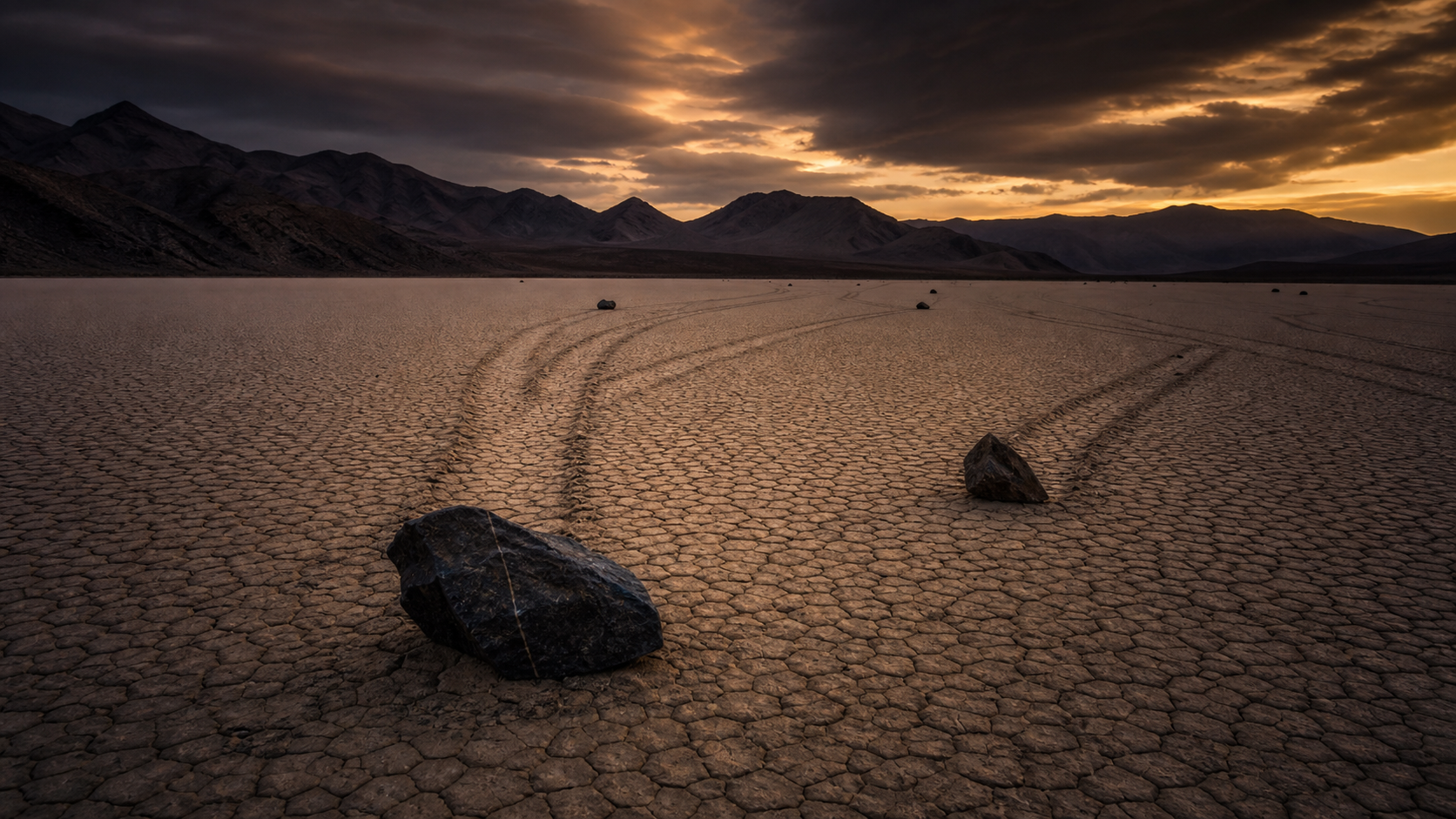
The Desert Floor Where Rocks Leave Trails
In Death Valley, stones leave tracks across a dry lakebed through a rare and surprisingly delicate chain of weather conditions.
In the Racetrack Playa, a dry lakebed in Death Valley National Park in California, rocks move. Not occasionally, not imperceptibly, not in any way that requires inference or instrumentation to detect. The rocks — some of them weighing hundreds of kilograms — leave long, clearly visible trails across the flat clay surface. The trails are real. The movement is real. For most of the twentieth century, no one knew what caused it.
Short answer: The rocks move because of a specific and unusual combination of winter rain, freezing temperatures, thin ice formation, and wind — a set of conditions that occurs rarely but produces, when it does, enough force to move even large rocks across the nearly frictionless wet clay. The mechanism was only directly observed and confirmed in 2014.
The Playa and Its Trails
The Racetrack Playa is a dry lakebed approximately four and a half kilometers long and two and a half kilometers wide, at an elevation of around eleven hundred meters. It is flat to a degree that is unusual even for desert playas: the difference in elevation between the north and south ends is less than five centimeters. The surface is cracked clay that, when dry, is hard and marked with the characteristic polygonal pattern of dried mud.
The moving rocks are found primarily at the southern end of the playa, where they have fallen or rolled from a rocky hillside called the Grandstand. They range from small pebbles to boulders weighing several hundred kilograms. Behind them stretch trails of varying length — some a few meters, some more than a hundred meters — with curves, parallel paths, and occasional right-angle turns that suggest multiple movement events over time.
The trails are preserved because the playa surface, once dry, hardens. Each movement event leaves a fresh impression in the surface that remains until the playa is wet again. Some rocks have trails that suggest they moved, stopped, and moved again in a different direction. Some parallel trails are nearly identical, suggesting groups of rocks moved simultaneously. Some trails end abruptly with the rock sitting at the end. Others suggest a rock fell over mid-journey.
Decades of Wrong Explanations
The moving rocks of Racetrack Playa were first documented scientifically in the 1940s and studied intensively from the 1970s onward. For decades, the mechanism remained genuinely uncertain. Proposed explanations included dust devils generating winds strong enough to push the rocks, microbial mats on the playa surface reducing friction, and various combinations of ice and wind that were never directly observed.
The difficulty was that the playa is remote, the movement events are rare, and no one had ever witnessed a rock moving. Researchers would arrive to find new trails that had not been there on their last visit. They could document that movement had occurred. They could measure the trails, weigh the rocks, and analyze the surface. But the event itself remained unwitnessed.
Several proposed explanations were ruled out through careful analysis. The rocks move in curved paths and make turns that dust devils could not produce. The soil under the trails shows no evidence of the kind of disruption that would occur if rocks were blown by direct wind force. The movement events appeared to correlate with winter conditions, but the specific mechanism was not established.
The Ice Raft Explanation
In 2011, a team of researchers from the Scripps Institution of Oceanography began an intensive study using GPS-equipped rocks, time-lapse cameras, and weather stations placed on the playa. In December 2013, conditions aligned: winter rain filled the playa with a shallow pond, overnight temperatures dropped below freezing, and a thin sheet of ice formed across the surface.
In the morning, as temperatures rose slightly and the ice began to melt at its edges, the researchers observed something that had never been directly witnessed before: the rocks were moving. The ice sheet, broken into panels by the warming, was being pushed by light wind across the thin film of water beneath it. The ice panels, carrying rocks frozen into their edges, slid across the nearly frictionless wet clay surface. The rocks moved slowly — sometimes only a few meters per minute — but steadily, following the direction of the wind and the movement of the ice.
The GPS data confirmed that multiple rocks moved simultaneously during the same event, which explained the parallel trails. The slow speed explained why the rocks' movement had never been noticed casually: on a short visit to the playa in winter conditions, you might not see the rocks moving even if they were. The movement was too slow and the events too brief to catch without sustained observation.
Why the Conditions Are So Rare
The ice raft mechanism requires a very specific combination of conditions: enough winter rain to flood the playa to a shallow depth, overnight temperatures low enough to freeze the surface, and enough morning warming to thaw the ice edges while still leaving water beneath. These conditions occur in Death Valley — which is, paradoxically, subject to cold winter nights despite its reputation as a hot desert — but only rarely and in the right sequence.
The playa's extreme flatness is essential. The nearly frictionless surface of wet clay, combined with the thin water layer that the ice floats on, allows the ice panels to move with very light wind force. On a rougher surface, the same conditions would produce no movement. On a steeper surface, the water would not pool to the right depth. The Racetrack Playa's particular geometry — flat, enclosed, at the right elevation — makes it the specific place where this happens.
What the Trails Have Recorded
The moving rock trails are a physical record of weather events. Each trail is a document of a specific winter, a specific combination of rain and freeze and wind, preserved in the dried clay until the next rain event rewets the surface and allows new movement. Some trails represent single events. Others show evidence of multiple events, with direction changes corresponding to different wind conditions on different occasions.
The rocks themselves are not special. They are the same dolomite and syenite that makes up the rocky hillside at the playa's edge. What is special is the environment they ended up in — a surface so flat, so dry most of the year, and so precisely calibrated for this unusual combination of conditions that it has become one of the few places on earth where the ordinary physics of ice, water, friction, and wind produces something that looks, to a casual observer, like the rocks are moving on their own.
The mystery was real for seventy years, and the explanation, when it came, was entirely mundane. That combination — genuine mystery, entirely ordinary mechanism — is what makes the Racetrack Playa worth the long drive across Death Valley to stand on its cracked surface and look at the trails the rocks have left behind.
| Feature | Why it matters |
|---|---|
| Extreme flatness of the playa | Allows ice panels to slide with minimal wind force |
| High desert elevation | Produces cold winter nights despite desert location |
| Clay surface when wet | Nearly frictionless; preserves trail impressions when dry |
| Rare rain events | Flood creates the shallow pond the ice forms on |
| Light winter winds | Enough to push floating ice panels carrying rocks |