
The Town That Disappeared Under a Lake
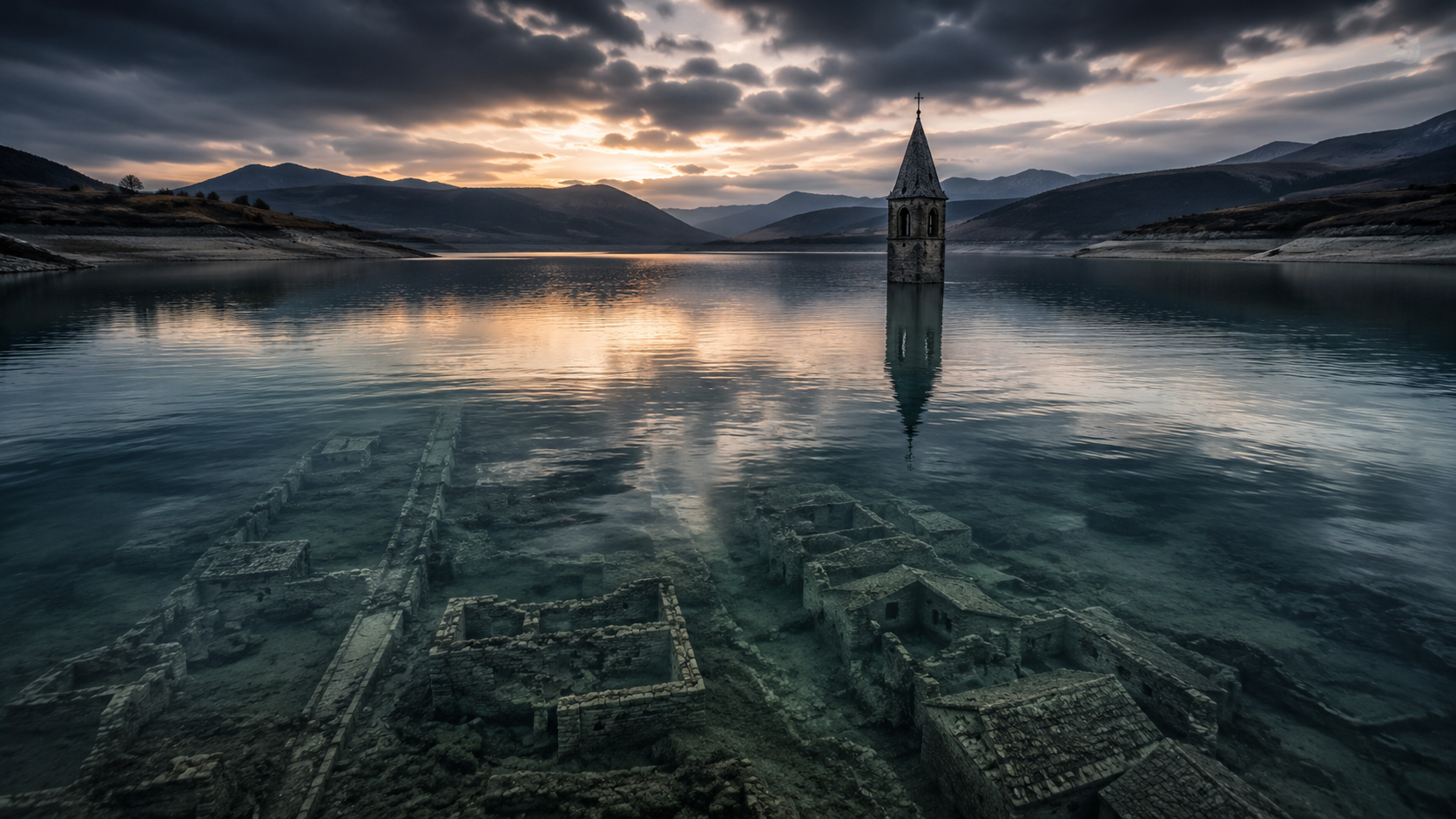
Somewhere beneath the still surface of a reservoir, there are streets. Foundations. A church tower that, in dry years, breaks the water line like a slow exhale.
Towns that were deliberately flooded — erased by governments, buried under engineering projects — exist all over the world. And people have not stopped thinking about them.
Short answer: Entire communities were intentionally submerged to build dams and water supplies. The towns are real, the displacement was real, and the emotional weight of what was lost has never fully settled.
When governments decided a town had to go
The decision to flood a town is never made quietly. It involves surveys, legal notices, relocation plans, and — almost always — intense resistance from the people who live there. But governments have done it repeatedly throughout the twentieth century and beyond, and the logic tends to follow the same shape: the water is needed. The town is in the way.
For the people being displaced, the math rarely feels clean. A town is not just land and structures. It is where someone was born, where their parents are buried, where the school still has their name carved into a desk. Losing all of that to a reservoir does not feel like a trade. It feels like erasure.
The strange part is what happens after. The water fills in. The surface goes flat and ordinary. Decades pass. And the town does not disappear from memory the way a demolished building might. It persists, beneath the surface, physically intact in some cases — just submerged.
The towns that sank and stayed
The most frequently cited example in Europe is Vilarinho das Furnas in Portugal. Flooded in 1971, the village sits under a reservoir that was built to supply hydroelectric power. In dry summers, when water levels drop, the granite walls emerge from the lake. Visitors stand at the edge and look down at roofless houses, doorways filled with silt, the bones of a community that was cleared out within living memory.
In England, the village of Ashopton was submerged in 1943 to create Ladybower Reservoir in Derbyshire. Residents were relocated, homes demolished. But the pub and some foundations were left, and in dry years their outlines surface. Photographs circulate every time it happens. People drive out to see it.
Potosí in Venezuela was flooded in 1985 when the Uribante-Doradas dam was completed. A church steeple remained visible for decades afterward, rising above the waterline like a marker. In 2010, a severe drought lowered the lake enough to reveal the town below — streets, walls, and the church standing, cracked but recognizable.
These are not isolated cases. Similar stories exist in China, Brazil, Spain, Italy, India, and across the American West. Each one follows the same arc: a community that existed, a decision made elsewhere, a flooding, a forgetting that never quite completes itself.
What remains beneath the water
Not every submerged town disappears at the same rate. Stone structures survive longer. Wooden buildings collapse quickly. What tends to remain are the things built to last: foundations, walls, church towers, stone bridges, old roads.
In some cases, artifacts have been recovered when the water dropped far enough. Furniture, tools, bottles, religious objects. In the Reschensee reservoir in northern Italy, a fourteenth-century church tower remains above the surface permanently — the village it served was flooded in 1950 — and it has become one of the most photographed landmarks in the region.
That tower is not marked as a ruin or a memorial. It simply stands there, in the middle of a lake, disconnected from anything visible above water. For people who know what it is, it carries an obvious weight. For those who do not, it looks like something left behind by an older, stranger world.
What usually survives: stone walls, foundations, roads, bridges, churches, and other structures built from durable materials are more likely to remain visible when water levels fall.
Why these places stay in the memory
The persistence of submerged towns in local memory is not just sentiment. It connects to something deeper about how people relate to place. A town that was burned or demolished is gone — its absence can be reconciled. A town that is still there, physically intact, just beneath a surface you cannot penetrate, creates a different kind of loss.
There is something unresolved about it. The buildings did not fall apart. The streets did not crumble. Everything is where it was. It is simply unreachable. That specific quality — the intactness, the proximity, the inaccessibility — is part of why submerged towns carry such a strong emotional charge.
Former residents have described returning to the shore of the reservoir and feeling like the town is waiting. That the water could be drained and life could resume, even though it could not. The rational mind knows the town is gone as a functioning place. The emotional mind keeps the image of it whole.
The dry years and what they reveal
Droughts have a way of returning these places to visibility. A long dry summer, a reduced snowpack, a drawdown for maintenance — and suddenly the water drops low enough for something to surface. A wall. A roofline. A road that still looks like a road.
When this happens, the response is always significant. People gather. Photographs spread. Local newspapers run stories. Former residents, some of them elderly, sometimes make the journey to stand at the water’s edge and look. The event carries the quality of a partial resurrection — not a return, but a glimpse.
What these moments reveal is how much meaning was attached to a particular geography. A town is not just a collection of functions — it is a specific arrangement of places that accumulate meaning over time. When the water drops and the outlines return, what people are seeing is not just stones. They are seeing the shape of a life that was interrupted.
| What was flooded | What it left behind |
|---|---|
| Vilarinho das Furnas, Portugal (1971) | Granite walls visible in dry summers |
| Ashopton, England (1943) | Pub foundations surface in drought years |
| Potosí, Venezuela (1985) | Church steeple visible above waterline for decades |
| Curon Venosta, Italy (1950) | 14th-century tower permanently above the surface |
What these towns tell us about loss
A submerged town is a specific kind of monument. It was not built to commemorate anything. It was not designed to endure. It simply exists, under water, in a state of suspended incompletion.
For the people who came from these places, the flooding represents a rupture that was never repaired. The relocation assistance helped. The new houses helped. But the specific geography — the particular hill, the specific curve of the main road, the view from the church steps — cannot be replaced or relocated. It can only be lost, and then occasionally glimpsed again when the water runs low.
The towns that disappeared under lakes did not disappear cleanly. They stayed, just out of reach, and that is part of what makes them so difficult to let go of.
They are reminders that geography carries memory, and that memory does not drain away just because the water has risen.