
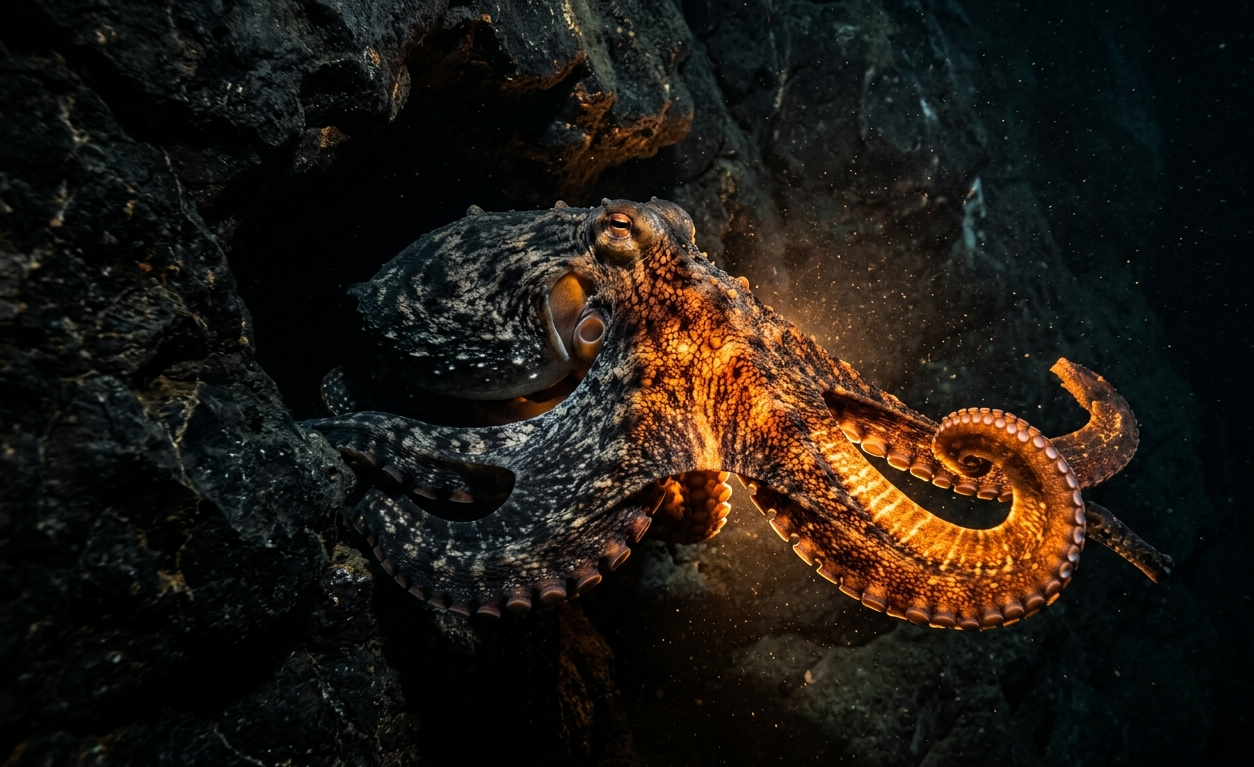
How Octopuses Change Color So Fast
An octopus can go from pale and smooth to dark, mottled, striped, or flashing in moments. That speed comes from a layered skin system used not just for camouflage, but also for signaling, hunting, defense, and stress.
A resting octopus on a reef can look like a lump of rock, then suddenly bloom into a high-contrast pattern that seems almost electric. If you are wondering how octopuses change color so fast, the short answer is that their skin is wired to the nervous system and packed with tiny color organs that can expand or contract in an instant.
But that answer is only the beginning. Octopus color change is not one trick. It is a stack of mechanisms working together: pigments, reflective layers, and even changes in skin texture. The result is one of the most flexible body displays in the animal world.
Short version: octopuses change appearance quickly because nerve signals control specialized skin structures called chromatophores, while deeper reflective layers and shifting skin texture add brightness, shimmer, and three-dimensional disguise. They use this system for octopus camouflage, communication, hunting, defense, and stress responses.
What octopus color change actually is
When people picture an octopus changing color, they often imagine the animal simply swapping one paint job for another. In reality, the change is broader than color alone. An octopus can alter shade, contrast, pattern, reflectivity, and surface texture all at once.
That is why the effect can seem almost impossible in real time. The animal is not merely turning brown or white. It may be creating blotches, bars, pale patches, dark eye spots, rippling signals, or a roughened skin surface that helps it match coral, sand, rock, or algae.
So the better question is not just “how does it change color?” but “how does its entire skin display system work?” The answer starts with chromatophores.
How chromatophores work
Chromatophores are tiny pigment-containing organs in the skin. Each one is like a small elastic sac filled with color. When surrounding muscles pull it open, the pigment spreads into a wider visible spot. When those muscles relax, the spot shrinks and becomes much less visible.
The crucial detail is speed. Those muscles are controlled by the nervous system, so the octopus does not need to wait for slow chemical changes the way some other animals do. A nerve signal arrives, the pigment organs expand or contract, and the visible pattern changes almost immediately.
Different chromatophores contain different pigments, commonly in yellow, red, brown, or black ranges. By opening some and closing others across thousands of tiny points on the skin, the octopus can produce remarkably complex displays.
Why this system is so fast
- The skin is directly controlled by nerves rather than relying only on slow hormonal shifts.
- Each chromatophore can change size quickly through muscle action.
- Thousands of these units work together at once, creating full-body patterns.
- The brain can coordinate local and whole-body displays depending on the situation.
Important distinction: chromatophores produce much of the visible color pattern, but they do not explain the whole effect by themselves. Reflective layers underneath them add another level of control.
The role of iridophores and skin texture
Beneath the chromatophores are other skin structures that affect how light behaves. One important group is often referred to as iridophores. Instead of relying on pigment, these layers reflect and scatter light, which can create iridescent or shimmering effects.
That means what octopus skin can do is not limited to “dark versus light.” It can also become more reflective, more metallic-looking, or visually more complex depending on the angle and the lighting.
Then there is texture. Many octopuses can raise little bumps and folds on the skin, called papillae, to shift from smooth to rough. A smooth pale body on open sand is one thing. A knobby, shadowed, mottled body next to rock is something else entirely.
| Skin feature | What it does | Why it matters |
|---|---|---|
| Chromatophores | Expand and contract pigment sacs | Create fast visible color and pattern shifts |
| Iridophores | Reflect and scatter light | Add shimmer, brightness, and optical effects |
| Skin papillae | Change surface texture | Help mimic rocks, coral, algae, and rough seafloor |
Camouflage versus communication
The most famous use of rapid color change is octopus camouflage. An octopus hiding on a reef or on the seafloor can break up its outline and blend into the visual noise around it. This reduces the chance of being noticed by predators and can also help it approach prey.
But camouflage is not the whole story. Octopuses also use changing displays for octopus communication. A body pattern can act like a signal: warning, aggression, readiness to mate, territorial tension, or general arousal.
That is where the difference between camouflage vs communication becomes useful. Camouflage tends to reduce visibility. Communication often does the opposite. It can make the animal more conspicuous, especially to another octopus nearby.
| Purpose | Typical visual strategy | What it may achieve |
|---|---|---|
| Camouflage | Mottled, broken, environment-matching pattern | Helps the octopus disappear into reef, sand, or rock |
| Communication | High contrast, directional, or attention-grabbing display | Signals mood, intent, rivalry, or reproductive state |
| Stress response | Sudden blanching, darkening, or unstable pattern shifts | Reflects agitation, fear, or physiological arousal |
Why the same skin system can do both
The genius of the system is flexibility. The octopus does not need separate organs for hiding and signaling. It uses the same skin hardware in different ways depending on context. A pattern that is useful in one moment can be abandoned in the next.
Hunting and defense
Color change also plays a role in feeding. An octopus stalking prey may adopt a lower-contrast pattern that helps it approach crabs, fish, or other animals without standing out. In some cases, a sudden shift in appearance may also confuse prey in the final instant before a strike.
On the defensive side, rapid display changes can startle a threat. A body that abruptly darkens, flashes, or throws strong contrast may buy a fraction of a second of confusion. For a soft-bodied animal with many predators, that moment matters.
Defense is not only about disappearing. Sometimes it is about disrupting recognition. If the predator cannot easily lock onto the octopus’s outline or interpret what it is seeing, the octopus gains an advantage.
- Stealth hunting: blending into the background while creeping toward prey.
- Ambush positioning: looking like part of the seafloor until the strike.
- Threat display: becoming darker, bolder, or more dramatic when alarmed.
- Escape support: changing appearance while moving away, often alongside other defensive behaviors.
What stress can look like
Octopus stress response can show up in the skin, but it is not always a single universal pattern. Stress may appear as rapid darkening, sudden paling, patchy instability, strong contrast, or repeated shifts that look less controlled than ordinary camouflage.
In simple terms, a calm octopus often looks deliberate. A stressed one may look abrupt, tense, or visually unsettled. Researchers and keepers sometimes watch for these changes alongside posture, movement, breathing rate, and attempts to flee or hide.
One reason this matters is that people sometimes assume every dramatic pattern is a display of intelligence or theatrical communication. Sometimes it is a sign the animal is overstimulated, threatened, or physiologically strained.
Caution: stress patterns can vary by species and situation. It is safer to think of them as context-dependent signals rather than a single fixed “stress color.”
Common signs that may accompany stress-related color change
- Very rapid switching between patterns
- Sudden blanching or darkening
- Tight posture or defensive body positioning
- Retreating, jetting away, or pressing into shelter
- Raised texture combined with strong contrast
Why octopuses are hard to study
Part of the challenge is that octopuses are both flexible and individual. Different species live in different habitats, and even within a species, the same display may not mean exactly the same thing in every context. A hunting pattern, a warning display, and a stress response can overlap visually.
They are also difficult subjects because their behavior changes with environment, lighting, nearby animals, and disturbance. A pattern seen in a lab may not map neatly onto what happens on a reef. And a wild octopus may react differently the moment it notices a diver or camera.
That makes interpretation tricky. Scientists can describe the mechanics of the skin fairly well, but assigning a precise meaning to every pattern is harder. Octopuses do not hold still, they do not repeat on command, and they often respond to the observer.
This is part of what makes them so compelling. Their displays are fast, context-rich, and deeply tied to behavior, which means they are scientifically valuable but not always easy to decode.
Why this adaptation is so unusual
Many animals can change appearance in some way, but the octopus system stands apart because of its speed, precision, and layering. It is not just fast pigmentation. It is fast pigmentation plus reflective control plus texture control, all coordinated through a sophisticated nervous system.
That combination gives octopuses an extraordinary range. They can vanish into a reef, signal to a rival, shift during a hunt, or show visible signs of stress in seconds. Few animals can move across those functions so fluidly using the same body surface.
The result is one of nature’s strangest visual technologies: living skin that acts like camouflage fabric, display screen, and emotional indicator all at once.
So, how do octopuses change color so fast? By using nerve-controlled chromatophores for rapid pigment display, reflective layers like iridophores for optical effects, and adjustable skin texture for physical disguise. The speed comes from direct control. The versatility comes from stacking several systems together.
And the reason they do it goes far beyond hiding. Octopus color change supports camouflage, communication, hunting, defense, and stress response, which is exactly why it remains one of the most remarkable adaptations in animal biology.