





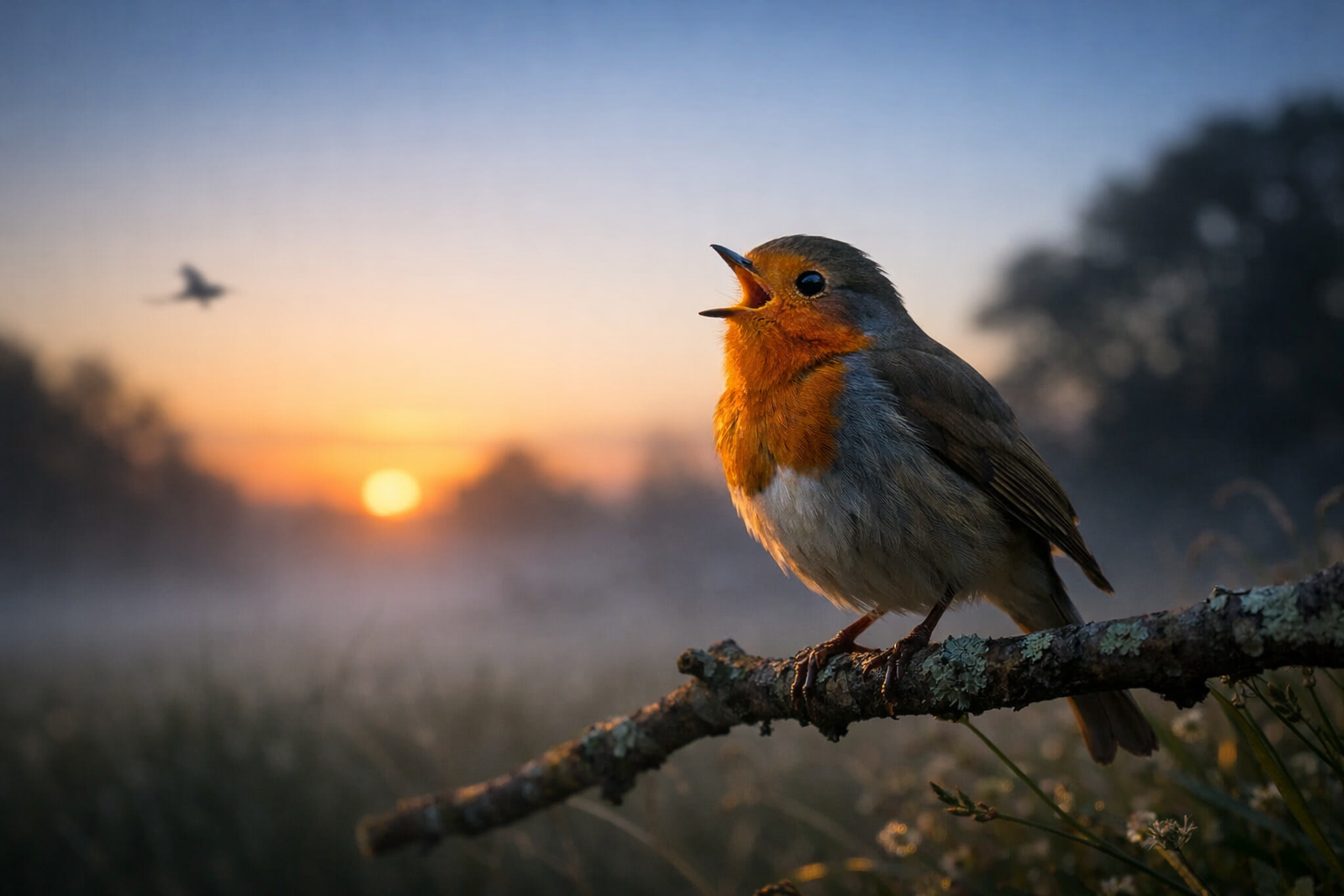

Why Some Birds Sing Before Sunrise: The Real Reason for the Dawn Chorus
The answer to why birds sing at dawn is less romantic than it sounds: early morning gives birds a rare mix of low light, calm air, and high acoustic payoff, making it the perfect time to advertise territory, signal fitness, and stay in contact before the day’s feeding begins.
If you have ever wondered why birds sing before sunrise, the short answer is that dawn is one of the best times of day for sound to matter. Many birds cannot forage efficiently in very low light, so the early morning window is ideal for singing instead: they can broadcast who they are, where they are, and how strong they are before the sun is fully up.
Short version: the dawn chorus happens because early morning often offers calmer air, less visual activity, and a temporary pause before feeding. Birds use that window for bird communication, especially territory defense and mate attraction. It is not just “celebrating the sunrise.”
What the dawn chorus actually is
The dawn chorus is the burst of morning bird song that builds in the period just before and just after sunrise. It is most noticeable in spring and early summer, when breeding activity is high, but it can happen in other seasons too depending on species, climate, and location.
It is not one unified choir in the human sense. It is many individual birds, often from different species, each giving calls or songs that serve specific purposes. Some are declaring territory. Some are trying to attract or maintain a mate. Some are keeping track of neighbors. Others are simply following a daily rhythm wired into their biology.
Songbirds usually dominate what people think of as birdsong before sunrise, but even within that group the pattern varies. A robin may begin earlier than a finch. A blackbird may hold a prominent perch and sing long, rich phrases, while other birds give shorter, sharper sequences. The chorus is really a layered soundscape made up of overlapping strategies.
Important distinction: in bird biology, a “song” is usually more complex and often linked to breeding or territory, while a “call” is typically shorter and used for contact, alarm, or coordination. The dawn chorus is mostly about songs, though calls can be mixed in.
Why dawn is such a good acoustic window
One of the clearest explanations for why birds sing at dawn is that sound works especially well then. Early morning often has less wind, less turbulence, and less background noise from insects, traffic, and daytime animal activity. Under those conditions, songs can carry farther and stay clearer.
Birds rely heavily on sound because they often cannot see one another through foliage, distance, or dim light. A well-timed song lets a bird project information across a territory without having to chase every rival physically. That saves energy and reduces risk.
Before sunrise, visibility is still poor enough that many birds are not yet feeding at full efficiency. In other words, there is less opportunity cost. If a bird cannot easily search for food in near-darkness, spending that time singing makes sense.
Why this timing works so well
- Low light can make feeding, hunting, and visual displays less effective.
- Cool, calmer morning air often helps songs travel more cleanly.
- There is usually less competing noise than later in the day.
- Birds can announce territory boundaries before daily movement increases.
- Potential mates and nearby rivals are likely to be listening at the same time.
This is one reason the dawn chorus is often strongest during breeding season. The value of being heard is especially high when territories are active and reproductive success depends on status, stamina, and timing.
Territory, mates, and competition
A huge part of birdsong at sunrise is social competition. Singing is a way to say, “This space is occupied,” without constant physical conflict. For a territorial bird, repeated song can warn rivals before they cross a boundary. That matters because fighting is costly.
Dawn song can also function as a signal to mates or potential mates. In many species, song quality, timing, and persistence may reflect condition. A bird that sings strongly at first light may be advertising that it survived the night, holds a territory, and has enough energy to invest in signaling.
This does not mean the song is a simple honesty test with one universal meaning. Different species use song differently, and even within a species the same song can carry multiple messages at once. But territory defense and mate-related signaling are among the most widely supported explanations for the dawn chorus meaning.
| Main function | What the song may communicate |
|---|---|
| Territory defense | This area is occupied, and a rival should keep its distance. |
| Mate attraction | The singer is present, active, and potentially high quality. |
| Pair bonding | A mated bird may reinforce contact or coordination with a partner. |
| Neighbor assessment | Birds can monitor who is nearby, who is absent, and who is escalating. |
If you are interested in how animals send fast, meaningful signals with their bodies, a very different but related example is how octopuses change color so fast. The mechanisms are nothing alike, but both cases show that animal communication often depends on timing, context, and what nearby animals can detect.
How light and temperature shape morning song
Light is one of the biggest triggers for daily bird behavior. Birds are extremely sensitive to changing light levels, and many species begin activity when the sky is brightening even before the sun is visible. That is why birdsong before sunrise can begin in very dim conditions.
But not all birds respond to light in the same way. Species that can function in lower light may start earlier. Birds with larger eyes relative to body size, birds that use high perches, or birds that rely heavily on acoustic signaling may enter the chorus sooner than species that wait for better visibility.
Temperature matters too, though usually as part of a larger package. Cool early air can affect insect activity, plant moisture, and the cost of movement. If food is not yet easy to find, singing may remain the best use of time. Once the day warms and feeding opportunities improve, many birds shift attention away from prolonged song.
Why low light changes the morning schedule
- Foraging can be harder when birds cannot see food well.
- Visual courtship displays are less useful in dim conditions.
- Sound becomes a more efficient way to communicate over distance.
- As daylight strengthens, birds can switch from signaling to feeding.
This is why the dawn chorus usually peaks and then fades rather than continuing at the same intensity for hours. The environment changes quickly, and so does the best use of a bird’s energy.
Why some species dominate the chorus
Not all birds sing equally at dawn. Some species are famous for it, while others contribute little or not at all. That difference comes down to ecology, anatomy, behavior, and daily routine.
Songbirds are especially prominent because they have complex vocal systems and often use elaborate songs in breeding contexts. Birds that defend territories with sound, perch conspicuously, and become active early are more likely to stand out in the chorus.
Species also differ in when they enter the soundscape. Some start well before sunrise. Others join only as light improves. In mixed habitats, the order can be surprisingly consistent from day to day.
| Bird type | Likely dawn chorus role |
|---|---|
| Territorial songbirds | Often major contributors because song is central to breeding and boundary defense. |
| Flock-oriented birds | May use more calls than full songs, depending on social structure. |
| Ground foragers | Some wait for better light before becoming strongly active. |
| Nocturnal or crepuscular species | May overlap with the chorus briefly but follow different rhythms. |
So, do all birds sing at dawn? No. Some species barely participate, some are much louder in other parts of the day, and some use sound in ways humans do not immediately recognize as “song.” The dawn chorus is real, but it is not universal.
Does weather affect birdsong before sunrise?
Yes. Weather can change both how well sound travels and whether singing is worth the effort. Calm, stable mornings often support stronger choruses. Rain, heavy wind, or sudden cold can reduce singing or delay it.
Wind matters because it disrupts the clean transmission of sound. Rain adds noise and can make exposed singing perches less attractive. Thick cloud cover can alter light cues, and abrupt weather shifts can change feeding priorities.
That said, weather does not switch birds on and off in a simple way. Some species keep singing under conditions that silence others. Local habitat matters too. A sheltered woodland edge may still carry song well even when open ground is windy.
Practical takeaway: if a dawn chorus sounds weaker on one morning than another, it does not necessarily mean fewer birds are present. It may just mean the acoustic conditions, light cues, or immediate priorities have changed.
Common myths about birds singing at dawn
Because the dawn chorus feels dramatic and familiar, people often attach simple explanations to it. Most of them are incomplete.
Myth: birds sing at dawn because they are happy the sun came up
It is understandable to describe it that way, but it is not a scientific explanation. The better answer is that dawn creates a useful communication window tied to territory, mating, and daily rhythms.
Myth: the chorus is mainly random noise
It can sound chaotic to us, but much of it is structured signaling. Birds are not just making sound for the sake of it. They are broadcasting information to other birds.
Myth: every species joins in the same way
They do not. Some species are early specialists. Some are quiet. Some rely more on calls than songs. The chorus is uneven by design.
Myth: louder birds are always stronger or healthier
Song can reflect condition, but not in a simple one-to-one way. Age, status, location, timing, experience, and species-specific behavior all matter.
Myth: birds only sing when other senses are unavailable
Sound is not a backup system. For many birds, it is a primary way to manage social life across distance. Dawn simply makes that channel especially useful.
Humans are very good at imposing familiar meanings on complex signals. That tendency shows up well beyond bird behavior; for a perception-based example, see what is pareidolia and why the brain keeps finding patterns that feel immediately meaningful.
What the dawn chorus reveals about bird behavior
The dawn chorus tells us that birds are not using sound casually. They are using it strategically. The timing of morning song reflects tradeoffs between visibility, feeding, energy, competition, and reproduction.
It also shows how tightly animal behavior is linked to the physical environment. Light level changes by the minute. Air conditions shift. Rivals wake up. Mates listen. Food becomes easier to find. The chorus emerges from that moving system rather than from one single cause.
That is the real reason birds sing at dawn: dawn is when the payoff for singing can be unusually high. It is a narrow window where sound travels well, social stakes are high, and other tasks are still partly on hold.
So if you hear intense morning bird song before sunrise, you are listening to more than background nature noise. You are hearing territory claims, mate signals, daily timing cues, and species-specific behavior all compressed into one brief part of the day.
If you want another animal-behavior mystery that turns out to have a surprisingly physical explanation, explore how octopuses change color so fast next.