




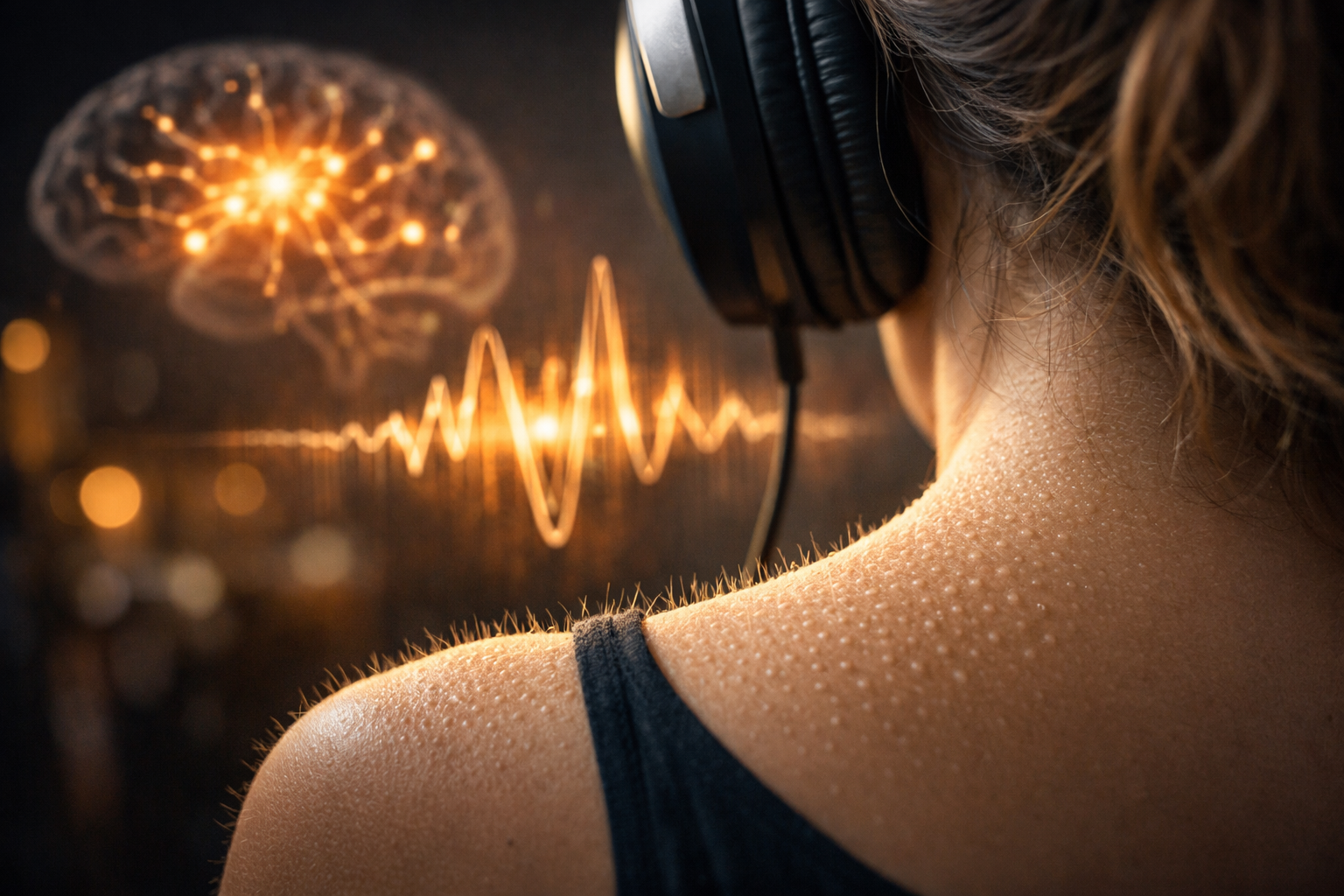

The feeling often arrives in a flash: a swell in the chest, a shiver down the arms, tiny hairs lifting on the skin. When people ask why music gives goosebumps, they are usually describing a phenomenon called frisson—a brief, intense response that is emotional and physical at the same time. Certain sounds, especially moments of tension and release, can push the brain’s reward and attention systems into a state of heightened alert. The body then follows with chills, goosebumps, or a wave-like rush.
Short version: music chills happen when the brain strongly anticipates what comes next, gets a meaningful payoff or surprise, and tags that moment as emotionally important. The result can feel mystical, but the mechanism is concrete: prediction, reward, arousal, and bodily response firing together.
What frisson means
Frisson meaning is simple at its core: it refers to a sudden thrill or shiver. In music research, the word usually describes those brief peaks when a song seems to hit the nervous system with unusual force. People may feel goosebumps, tingling, a lump in the throat, tears, a racing heart, or a sense that time briefly sharpened.
It is not just “liking a song a lot.” Plenty of music is enjoyable without producing chills. Frisson is more specific. It tends to happen at particular moments: a voice enters after a long pause, harmony opens up, a beat drops at exactly the right second, an unexpected chord lands, or a melody rises in a way that feels both surprising and inevitable.
That is why the reaction can feel so distinct. It is not a general mood spread evenly across a whole track. It is often a spike.
Useful distinction: frisson is not the same thing as being cold, startled, or scared, even though the body can borrow some of the same physical machinery, including goosebumps and a quick jolt of arousal.
Why the brain loves prediction and surprise
A big part of why songs trigger chills has to do with prediction. The brain is not a passive listener. It is constantly guessing what will happen next: where the beat will land, when a phrase will resolve, whether the singer will rise or fall, whether the chorus is coming, whether tension will hold or break.
Music is especially good at engaging this system because it unfolds through time. A painting is all there at once. A song makes you wait. That waiting matters. The brain tracks patterns, builds expectations, and becomes invested in whether those expectations are confirmed, delayed, or violated.
When a piece of music plays with expectation skillfully, it creates a sweet spot between predictability and surprise. Too obvious, and the brain relaxes. Too chaotic, and the brain struggles to form meaningful expectations. But when the structure is understandable and then slightly bent, the payoff can be powerful.
This prediction machinery is not unique to music. It shows up across perception more broadly. The same brain that rapidly searches for meaning in sound is also quick to impose patterns on sight, which is part of why articles on what is pareidolia? why your brain keeps seeing faces in random things feel strangely related to music chills. In both cases, the mind is actively constructing reality, not merely receiving it.
What the brain is doing during a chills moment
- Tracking patterns in rhythm, melody, harmony, and timing
- Building expectations about what should happen next
- Flagging especially meaningful surprises or delayed resolutions
- Activating reward systems when the musical payoff lands
- Triggering bodily arousal that can show up as tingling, chills, or goosebumps
The role of buildup and release
If anticipation matters so much, then buildup matters too. Many of the strongest music chills arrive after tension has been carefully held in place. A song hints at release, then delays it. It narrows the emotional funnel. Attention tightens. The body waits.
Then something opens: the drums fully enter, the harmony resolves, the singer reaches the high note, the choir appears, the bass drops out and slams back in, the melody finally lands where it has been wanting to go. That release can feel physical because the nervous system has been primed for it.
This is one reason people often report chills at transitions rather than during steady sections. The body reacts less to a static emotional state than to a shift in state. Frisson tends to live at the edge between before and after.
The pattern is familiar far beyond music. Timing changes the meaning of sound in many systems, including nature. If you enjoy this kind of sensory explanation, the piece on why some birds sing before sunrise: the real reason for the dawn chorus explores how timing and acoustic conditions can make sound far more effective.
Why some songs hit harder than others
Not every song is built to create frisson, and not every listener brings the same history to a song. That is why one person gets chills from a string arrangement while another gets them from a bass drop or a gospel vocal run.
Some musical features are especially effective:
- Unexpected but coherent changes: the moment surprises you without feeling random.
- Rising intensity: crescendos, layering, and swelling textures can prime the body.
- Human voice: vocals often feel especially direct because the brain is highly tuned to human sound.
- Personal meaning: memory, heartbreak, nostalgia, grief, awe, or identity can load a moment with extra weight.
- Skilled pacing: the song knows when to hold back and when to release.
Personal context matters more than people sometimes realize. A song tied to a breakup, a funeral, a first love, a childhood place, or a powerful live performance can trigger stronger chills because the music is not acting alone. It is touching stored emotion. The sound becomes a key that opens something already waiting.
That helps answer whether the reaction is emotional or physical. It is both. The emotional meaning of the music shapes the response, but the response is carried out through the body: skin conductance shifts, heart rate can change, attention narrows, and goosebumps may appear.
Why vocals often trigger chills
The human voice carries more than pitch. It carries breath, strain, fragility, force, and tiny cues of intention. A cracked note, a sudden leap, or a choir joining in can feel biologically salient in a way pure instrumental sound sometimes does not. The brain treats voices as socially important signals, which can amplify the emotional response to music.
Who is more likely to feel chills
Some people experience frisson often. Others almost never do. That difference appears to reflect a mix of personality, attention, emotional openness, and listening style rather than a simple “music lover” versus “non-music lover” split.
People who tend to become deeply absorbed in aesthetic experiences may be more likely to feel chills. So may people who listen actively rather than using music only as background. Familiarity also matters. Knowing a song well can strengthen anticipation, which makes the payoff more precise. But novelty can matter too, especially when a new sound lands in a striking way.
So if you rarely get chills, that does not mean music is “working” less on you. It may simply mean your strongest responses take a different form: calm, sadness, joy, movement, memory, or sustained mood rather than a sharp physical surge.
When the response is normal
In most cases, chills from music are entirely normal. They are a sign that sound has engaged attention, emotion, and physiology all at once. The body is reacting to meaning, not to danger.
The response can include:
- Goosebumps on the arms, neck, or scalp
- A wave of tingling or shivering
- Tears or a sudden feeling of fullness in the chest
- A brief sense of awe, release, or emotional clarity
- Strong focus on a specific musical moment
What makes it feel unusual is that modern life does not offer many socially acceptable situations where a few seconds of sound can visibly move the body. But the mechanism itself is not exotic. It is the nervous system doing what it does best: deciding that a pattern matters and mobilizing a response.
Common myths about music goosebumps
Myth: It is purely emotional, not physical
False. The emotional response to music is real, but so is the bodily response. Frisson is exactly interesting because it bridges the two.
Myth: Only sad songs cause chills
Not at all. Sadness can trigger chills, but so can awe, triumph, beauty, nostalgia, spiritual feeling, tenderness, or sheer sonic impact.
Myth: Goosebumps mean a song is objectively better
No. A chills response says more about the interaction between the song, the moment, and the listener than about universal quality. One person’s overwhelming chorus is another person’s shrug.
Myth: The feeling is random
It can feel random in the moment, but it usually is not. When you look closely, chills often cluster around specific musical structures: expectation, tension, surprise, release, and emotional relevance.
The core idea: when people ask why songs trigger chills, the best answer is that music can manipulate expectation with extraordinary precision, then attach that timing to emotion. The body responds because the brain treats the moment as significant.
So why do some songs give you goosebumps? Because the right piece of music can make the brain predict, wait, hope, and then get rewarded in a concentrated burst. That burst is felt as emotion, but it is also measured in the body.
Frisson is one of those rare experiences that makes the nervous system briefly visible. A song builds tension, your brain leans forward, the payoff lands, and your skin tells the story.
If this kind of explanation is your thing, keep going through Oddlyz’s brain-and-behavior pieces. The same pattern-hungry mind that can be shaken by a chord change is also the one that finds faces in ordinary objects, hears structure in dawn soundscapes, and keeps turning raw sensation into meaning.